Almost every Christmas culture has someone who brings the gifts. In the United States and much of the world it is Santa Claus, a round, red suited man with a sleigh and a workshop at the North Pole. But travel a little and the gift bringer changes. He might be a stern bishop, a kindly witch, three traveling kings, a frost covered wizard, or a gnome who lives under the floorboards.
What ties them together is older than any of them. Behind the sleigh and the reindeer stands a real person: a Christian bishop who lived seventeen hundred years ago. This guide traces how that one man became Santa Claus, untangles the popular myth that Coca-Cola invented the red suit, and introduces the gift bringers who deliver presents across the rest of the world.
For the wider story of the holiday, see our complete guide to Christmas, and for the deeper timeline our history of Christmas.
The Real Saint Nicholas
Santa Claus begins with a real man. Nicholas of Myra was a Christian bishop in the 4th century, in a Greek speaking town that sits in modern Turkey. Very little about his life can be confirmed, but the stories told about him all share one theme: secret, generous giving.
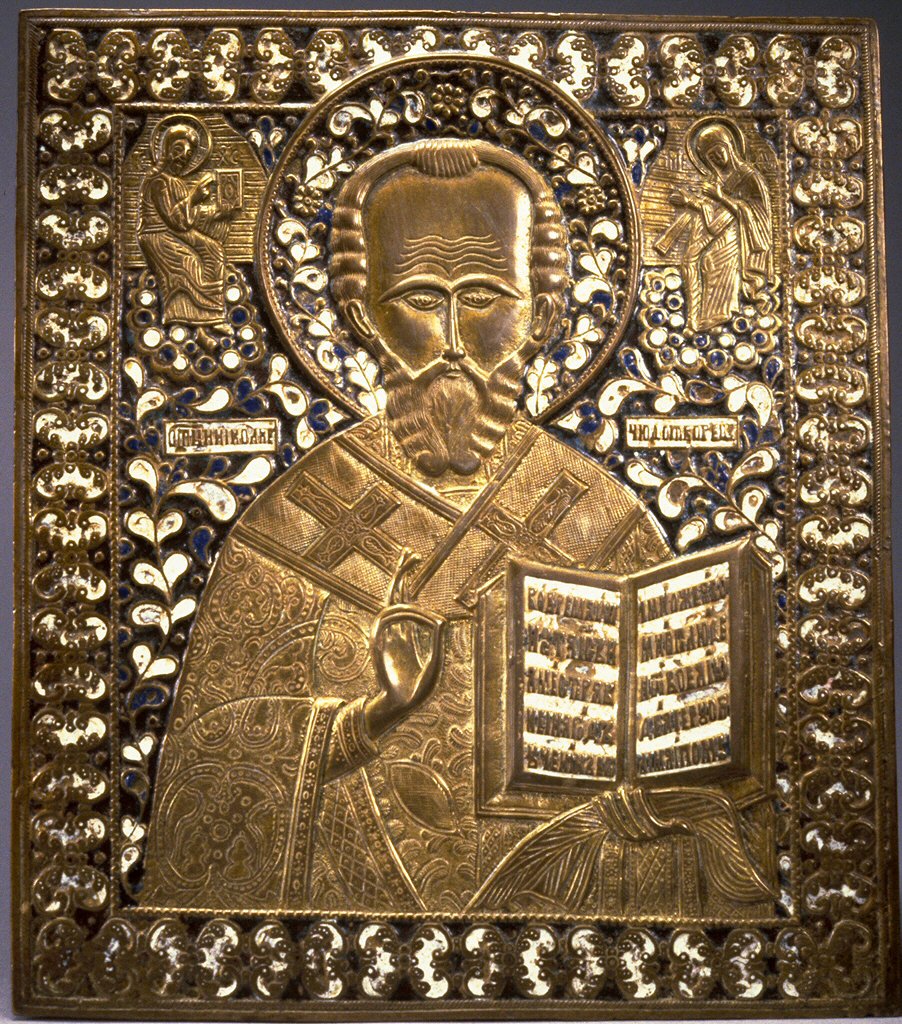
The most famous legend explains the gift giving we still copy today. A poor man had three daughters and no money for the dowries they needed to marry. To save them from a desperate future, Nicholas is said to have crept to the house at night and tossed bags of gold through the window, once for each daughter. In some versions the gold lands in stockings or shoes left by the fire to dry. That detail became the root of hanging stockings for Santa to fill.
Other stories cemented his fame. Sailors told how he calmed a deadly storm at sea and brought a drowned crewman back to life, and he became the patron saint of sailors. That helps explain why seafaring nations carried his cult so far and so fast. He is also claimed as the patron of children, students, and merchants. A famous if unverifiable tale even places him at the Council of Nicaea in the year 325, where he supposedly lost his temper and struck a man whose teaching he judged heretical. Whatever the truth of these stories, the picture they paint is consistent: a holy man defined by sudden, secret generosity.
Nicholas was made a saint, and his reputation as a protector of children and the poor spread across Europe. His feast day falls on December 6, close enough to Christmas that the two would eventually blend. In 1087 sailors carried his relics to Bari, in southern Italy, which remains a place of pilgrimage. By the Middle Ages he was one of the most beloved saints on the continent, and in many countries children still receive small gifts on his feast day rather than on the 25th.
The man behind the legend was very real. In modern times researchers studied the bones kept in Bari and built a reconstruction of his face. It suggested a figure a little over five feet tall with a heavy, broken nose, a small and very human person standing behind the towering myth.
How Saint Nicholas Became Santa Claus
The journey from a Mediterranean bishop to the modern Santa runs through the Netherlands and then across the Atlantic.
In Dutch tradition the saint lived on as Sinterklaas, a tall, dignified figure in red bishop’s robes. Dutch settlers founded New Amsterdam, the town that became New York, and the memory of Sinterklaas lingered there. The tradition was then revived and reshaped in the early 1800s by New York writers who were fascinated by the city’s Dutch past. Over time English speakers turned the Dutch name into Santa Claus. A New York newspaper referred to a version of the name as early as the 1770s.
Three American works then reshaped him into the figure we know:
- The writer Washington Irving poked gentle fun at New York’s Dutch heritage in the early 1800s and gave St. Nicholas a folksy, pipe smoking character.
- In 1823 a poem called “A Visit from St. Nicholas,” better known by its first line “Twas the night before Christmas,” gave Santa a sleigh, eight named reindeer, and a habit of coming down the chimney. It is usually credited to Clement Clarke Moore, though some scholars argue the real author was Henry Livingston Jr.
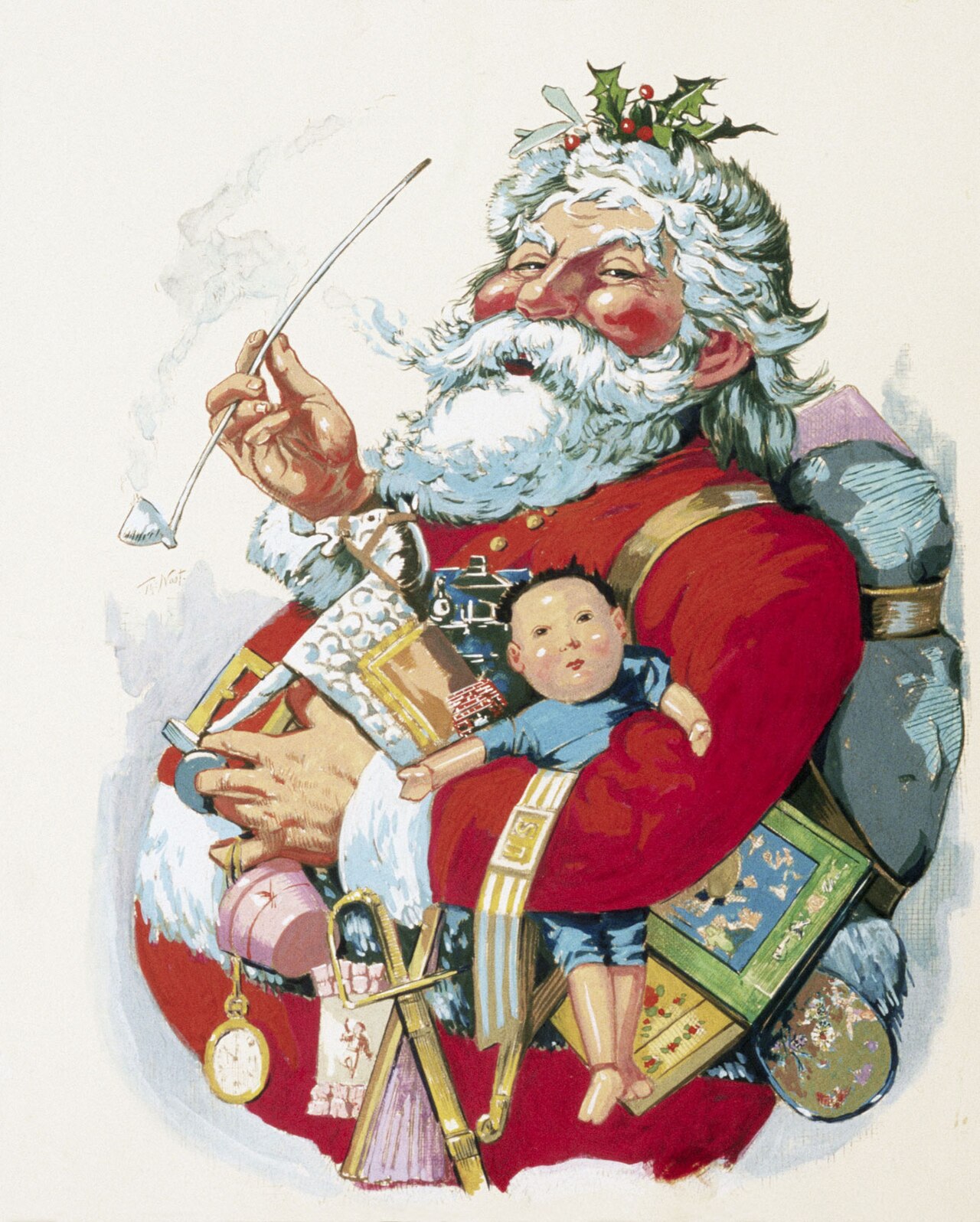
- From the 1860s the cartoonist Thomas Nast drew Santa year after year for Harper’s Weekly. Nast gave him a home at the North Pole, a workshop, and a ledger of which children had been good or bad.
By the end of the 1800s the American Santa was largely complete: jolly, bearded, fond of children, and already, in many color prints, dressed in red.
A few American touches came later. In 1897 a New York newspaper printed its famous reply to a young reader who had asked whether Santa was real: “Yes, Virginia, there is a Santa Claus.” It is still quoted every December. And in 1939 a Chicago department store gave Santa a ninth reindeer when a copywriter invented Rudolph the Red Nosed Reindeer for a giveaway booklet. The hit song that followed a decade later made Rudolph as famous as the original eight. Step by step, through a poem, a cartoonist, store displays, and advertising, a 4th century bishop had become a modern icon.
Why the Red Suit? The Coca-Cola Myth, Corrected
A story gets repeated every December: Santa wears red because Coca-Cola dressed him that way to match its branding. It is a tidy tale. It is also wrong.
Coca-Cola did run a hugely successful campaign. Starting in 1931 the artist Haddon Sundblom painted a warm, rosy cheeked Santa for the company’s advertisements, and those images ran for decades. They helped fix the modern look of Santa in the public mind, especially the friendly, grandfatherly face.
But the red suit came long before 1931. Consider the evidence:
- Saint Nicholas was a bishop, and bishops wore red robes. The color was linked to him for centuries.
- Thomas Nast and other illustrators were showing Santa in a red suit in color prints in the late 1800s.
- A 1906 magazine cover and advertisements from other companies, including a soft drink rival that used a red suited Santa in 1915 and again in the early 1920s, all predate Coca-Cola’s campaign.
Even Coca-Cola itself does not claim to have invented the look. The company’s own account credits Sundblom with popularizing a Santa who already existed. So the accurate version is simple. Coca-Cola spread and standardized the red suited Santa. It did not create him.
It is true that Santa was not always red. Some Victorian Christmas cards showed him in green, blue, or brown, and Nast’s earliest version wore a costume of stars and stripes for a Civil War magazine cover. But red steadily won out, carried by the bishop’s robes, the Victorian illustrators, and at last the high gloss of modern advertising.
Europe’s Cast of Gift-Bringers
Across Europe the saint splintered into a whole cast of characters. Some stayed close to the original bishop. Others wandered far from him.
Sinterklaas (Netherlands)

The Dutch kept the bishop. Sinterklaas still wears the red robes, the tall mitre, and carries a staff. He arrives by steamboat from Spain in mid November, and the main night of gifts is December 5, the eve of his feast. Children leave a shoe out, sometimes with a carrot or hay for his white horse, and find it filled by morning. His companion, Zwarte Piet, has become the subject of a serious national debate in recent years over a tradition many now see as a racial caricature, and the character is being changed in many places.
Père Noël (France)
In France, Père Noël (“Father Christmas”) fills the shoes children leave by the fireplace. In the eastern regions he sometimes travels with a darker companion, Père Fouettard, the “Father Whipper,” who deals with children who have misbehaved. Good children get sweets and toys. The naughty are promised a switch or a lump of coal.
The Christkind (Germany and Austria)
Here lies one of the great ironies of Christmas. During the Reformation, Martin Luther disliked the cult of saints and wanted to move the focus away from St. Nicholas. He promoted a new gift bringer, the Christkind, or Christ Child, an angelic, childlike figure who brought gifts on Christmas Eve itself. The idea was meant as a Protestant alternative. Today the Christkind is most associated with strongly Catholic regions like Bavaria and Austria, and a young woman is chosen each year to open the famous Christkindlesmarkt in Nuremberg. In much of northern and eastern Germany a secular Weihnachtsmann (Christmas Man), who looks much like Santa, now does the job instead, so the two figures live side by side across the country.
Father Christmas (England)
England’s Father Christmas did not start as a gift bringer at all. He began centuries ago as a cheerful personification of the holiday season itself, a symbol of feasting, drinking, and good cheer, with no connection to children or presents. Only later, under the influence of the American Santa, did the two figures merge into the gift giving Father Christmas of today.
Joulupukki (Finland)
Finland’s Santa carries a strange name. Joulupukki literally means “Yule Goat.” It points back to an older Nordic tradition in which a frightening goat figure, not a kindly old man, went from house to house. Over time the goat softened and merged with the imported Santa, but the old name stuck. Today Joulupukki is said to live in Finnish Lapland, and he often arrives in person on Christmas Eve to ask whether the children have behaved.
The Tomte (Scandinavia)
In Sweden, Norway, and Denmark the gift bringer grew out of folklore rather than sainthood. The Tomte (Jultomten in Sweden) or Nisse (Julenisse in Norway) is a small, bearded gnome who was believed to guard the farm and its animals. Families left him a bowl of porridge with butter to keep him content, because a slighted Tomte could turn mischievous. As Christmas customs spread, this household spirit took on the role of the one who delivers the presents.
Olentzero (Basque Country)
In the Basque Country of northern Spain, gifts come from Olentzero, a rough looking charcoal burner who comes down from the mountains at Christmas. Dressed as a peasant, with a pipe and a sack of presents, he is paraded through towns as a figure straight out of rural folk life rather than a saint or a king.
Mikulás (Hungary)
Hungarian children meet Mikulás, the local form of St. Nicholas, on the night of December 6. They polish their boots and set them on the windowsill, and in the morning find them filled with sweets, fruit, and nuts. A small golden switch may appear too, a gentle warning from Mikulás’s shadowy companion, the Krampusz.
Saint Basil (Greece)
In Greece the gifts often wait until the new year. The gift bringer is not St. Nicholas but Saint Basil (Agios Vasilios), another 4th century bishop, remembered for his care of the poor. Greek children receive their presents on January 1, St. Basil’s Day, and go from house to house singing carols called kalanda. Families cut a special cake, the vasilopita, with a coin baked inside. Whoever finds the coin in their slice is promised good luck for the year ahead.
Witches and Wise Men: Italy and Spain
In much of southern Europe the gifts do not arrive on December 25 at all. They come at Epiphany, on January 6, carried by figures with very old roots.
La Befana (Italy)
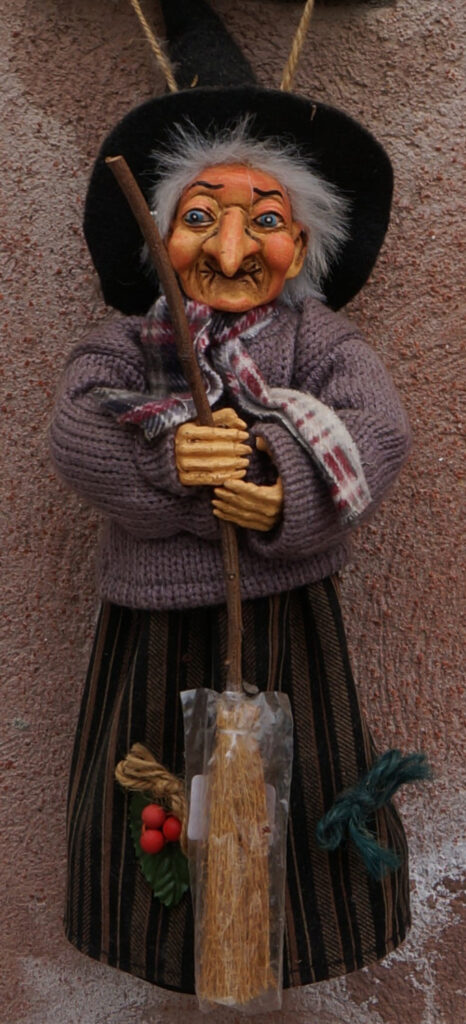
Italy’s beloved gift bringer is a witch. La Befana flies on a broomstick on the night of January 5 and fills children’s stockings with sweets, or with coal for the naughty. Folklore says the Three Kings asked her to join their journey to find the baby Jesus, but she was too busy and set out too late, and she has been searching and giving gifts ever since. The modern Babbo Natale (Father Christmas) now visits on the 25th as well, so many Italian children enjoy two rounds of presents. You can read more about her in our guide to Christmas around the world.
The Three Kings (Spain and Latin America)

In Spain and across Latin America the great gift giving night is the eve of Epiphany. The Three Kings, the Magi who brought gifts to the infant Jesus, are the ones who bring presents to children. On January 5, cities hold dazzling parades called cabalgatas, where the kings ride through the streets tossing sweets to the crowd. Children leave out their shoes, along with food and water for the kings’ camels, and wake on January 6 to gifts and a ring shaped cake, the roscón de Reyes.
Grandfather Frost: Russia and the East
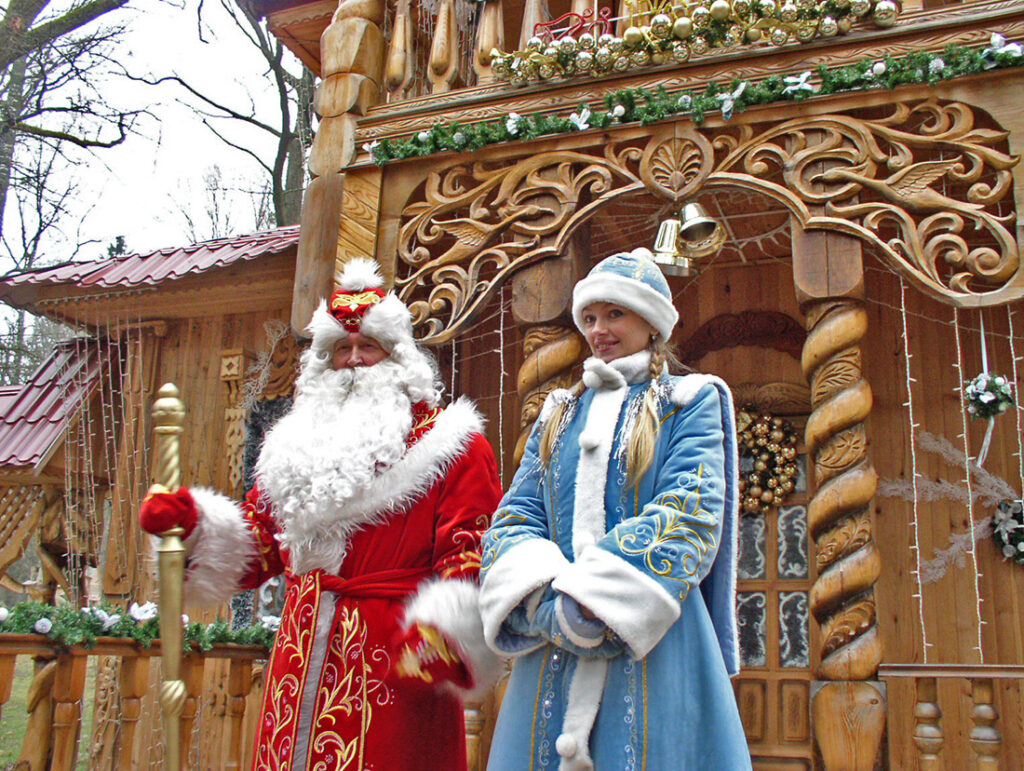
In Russia and many Slavic countries the gift bringer is not Santa but Ded Moroz, “Grandfather Frost.” He is a tall, imposing wizard of winter in a long robe of blue, silver, or red, and he carries a magical staff. Unlike Santa, he often appears with a helper: his granddaughter Snegurochka, the Snow Maiden.
His timing has a political history. Under the Soviet Union, religious Christmas was discouraged, so Ded Moroz was repurposed as a secular figure who delivers gifts at New Year instead. The custom stuck, and in much of the former Soviet world New Year, not Christmas Day, remains the big night for a decorated tree and presents. By tradition Ded Moroz lives in the northern Russian town of Veliky Ustyug.
The Dark Companions
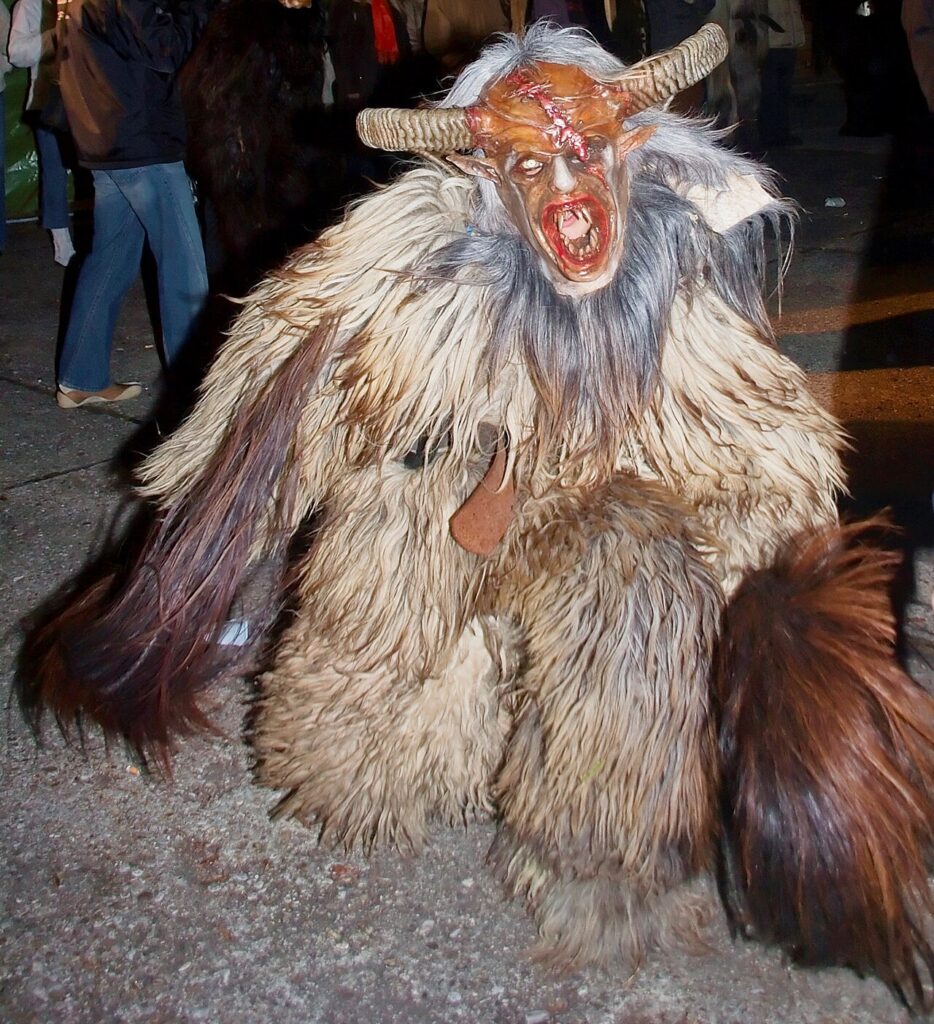
The cheerful gift bringer often travels with a shadow. Across Europe, the figure who rewards good children is paired with a frightening one who deals with the bad. The pairing is a kind of folk lesson, a reminder that generosity and consequence go together.
- Krampus (Austria and Bavaria): a horned, shaggy demon who accompanies St. Nicholas in early December. In Alpine towns, young men dress as Krampus and run through the streets in noisy parades called Krampusläufe.
- Knecht Ruprecht (Germany): a dark, bearded companion of St. Nicholas who questions children about their behavior and prayers.
- Belsnickel (German and Pennsylvania Dutch): a fur clad, wild looking figure who both hands out treats and raps at the window to scare children into being good.
- Père Fouettard (France): the “Father Whipper” who shadows Père Noël.
- The Yule Cat (Iceland): a giant cat said to prowl the countryside and eat anyone who did not receive new clothes before Christmas.
These darker figures are part of why Christmas folklore stays so vivid. For more of these regional customs, including the Krampus runs and the Icelandic Yule Lads, see our guide to 25 Christmas traditions around the world.
Beyond Europe: Newer Faces
As Christmas spread around the globe, new gift bringers appeared. Some are religious, some purely commercial.
Across much of Latin America, the gifts come not from Santa but from the Christ child. Known as El Niño Jesús or El Niño Dios, he is said to bring presents on Christmas Eve, while the Three Kings add a second round on January 6. In countries such as Colombia, Bolivia, and parts of Mexico and Central America, a child who asks “what did the baby Jesus bring you?” is talking about the gifts found on Christmas morning.
In China, where Christmas is not a public holiday, a cheerful commercial figure called Sheng Dan Lao Ren, the “Christmas Old Man,” appears in shops and malls in the larger cities. The evening has become popular with young people, who exchange apples wrapped in colored cellophane on Christmas Eve, a custom built on a pun in Mandarin between the words for “apple” and “peace.”
In Japan, Santa, known as Santa-san, is almost entirely a decorative and commercial figure rather than a true gift bringer. As our guide to Christmas around the world explains, the Japanese Christmas centers more on couples, bright illuminations, and a famous bucket of fried chicken than on a man climbing down the chimney.
The World’s Gift-Bringers at a Glance
| Figure | Where | Who or what they are | When gifts arrive |
|---|---|---|---|
| Santa Claus | United States, UK, much of the world | Jolly old man from the North Pole | December 25 |
| Saint Nicholas | Central Europe | The original gift giving bishop | December 6 |
| Sinterklaas | Netherlands, Belgium | Bishop in red robes | December 5 |
| Père Noël | France | Father Christmas | December 25 |
| Christkind | Germany, Austria | Angelic Christ Child | December 24 |
| Joulupukki | Finland | The “Yule Goat” Santa | December 24 |
| Tomte / Nisse | Scandinavia | Gnome like house spirit | December 24 |
| Olentzero | Basque Country | A charcoal burner | December 24 to 25 |
| La Befana | Italy | A kindly old witch | January 6 |
| The Three Kings | Spain, Latin America | The Magi | January 6 |
| Ded Moroz | Russia, Slavic countries | Grandfather Frost and Snegurochka | New Year |
| Saint Basil | Greece | A charitable 4th century bishop | January 1 |
| El Niño Jesús | Latin America | The Christ Child | December 24 to 25 |
One Saint, Many Faces
Pull back, and a pattern appears. A bishop, a witch, a frost wizard, a gnome, and three kings look nothing alike. Yet each one does the same job. Each rewards children, marks the darkest part of the year with generosity, and carries a quiet warning that kindness is expected in return.
That variety is worth celebrating. Behind the modern, commercial Santa stands a long line of saints, spirits, and seasonal characters, each shaped by a particular place and faith. Learning their names is a reminder that there is no single correct way to picture the giver of Christmas gifts.
Santa Claus is simply the version that traveled farthest, picked up a sleigh and a soft drink campaign along the way, and became global. The others are not lesser copies. They are the older, stranger, and often more interesting relatives he left behind. To see how these figures fit into the customs of each country, explore our Christmas around the world guide, or start with the main Christmas guide.