Christmas feels timeless. The tree, the carols, the gifts, the man in the red suit. Yet almost none of it arrived at once, and much of it is younger than people assume. The holiday we celebrate today was assembled slowly, over nearly two thousand years, from older festivals, a religious feast, scattered folk customs, and a burst of Victorian invention. No single person designed it. It grew.
This is the story of how Christmas came to be. It runs from the firelit winter festivals of the ancient world, through the early Christian Church and the medieval feast, to the Puritans who tried to ban it and the Victorians who brought it roaring back. By the end you will see why Christmas falls on December 25, where Santa really comes from, and how a quiet church feast became the most widely celebrated holiday on Earth.
Before Christmas: the festivals of midwinter
Long before there was a Christmas, people dreaded the dark. In the Northern Hemisphere the days shrink through autumn until the winter solstice, the shortest day of the year, around December 21. After that the sun climbs again and the light returns. For ancient communities this turning point was worth a celebration. The worst of winter still lay ahead, but the promise of spring had begun.
Across Europe and the Mediterranean, midwinter was a season of fire, feasting, and hope. Three of these older festivals left a clear mark on Christmas.
Roman Saturnalia
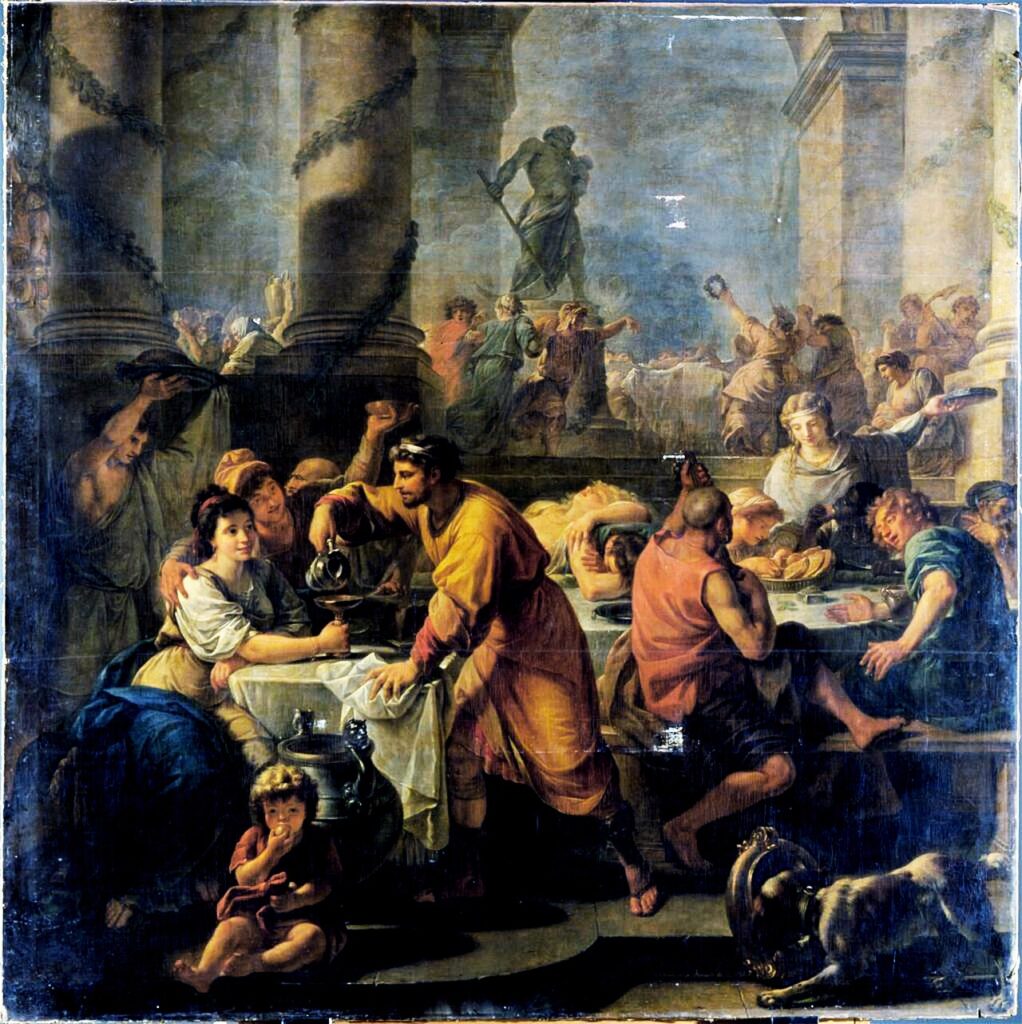
The Romans held Saturnalia in honor of Saturn, the god of agriculture and time. It began on December 17 and, by the late Republic, stretched on for about a week. Saturnalia was the most beloved holiday on the Roman calendar, and it was gloriously disorderly. Courts and schools closed. Work stopped. People decorated their homes with greenery, lit candles, gambled openly, and feasted.
The most striking feature was a season of reversal. Masters served their slaves at the table. Ordinary rules of dress and conduct were relaxed. Each household chose a mock “king of Saturnalia” to give comic orders. People exchanged small gifts, often candles or little clay figures. The mood was loud, generous, and a little chaotic. If parts of that sound familiar, that is the point. Feasting, greenery, candles, gift giving, and a break from the normal order all flowed forward into later winter holidays.
Norse and Germanic Yule
Farther north, Germanic and Norse peoples kept Yule, a midwinter festival that ran across several days around the solstice. Yule gave us the Yule log, a great log burned on the hearth, and it gave us the very word we still use for the season. Feasting, drinking, and gathering close against the cold were central. Evergreen boughs, which stayed green when everything else died back, were brought indoors as a sign of life enduring through winter.
Many small Christmas customs trace back to this northern world. The evergreen as a symbol of survival, the great communal feast, the warmth of a fire at the darkest time of year. These were not invented by Christianity. They were inherited from it.
The Unconquered Sun
There was also a Roman sun cult. In AD 274 the emperor Aurelian raised the worship of Sol Invictus, the “Unconquered Sun,” to new prominence. A festival of the Unconquered Sun, Dies Natalis Solis Invicti, came to be linked with late December and the season of the reborn sun, climbing again from its lowest point. Scholars still debate the details, including whether a fixed December 25 sun festival actually predated the Christian feast or grew up alongside it. Either way, the image of light returning at the year’s darkest hour sat close to a very different birth.
Why is Christmas on December 25?
Here is a fact that surprises many people. The Bible never gives the date of Jesus’s birth. The Gospel of Luke describes shepherds watching their flocks by night, which some read as a hint of a milder season, but no day or month is recorded anywhere in scripture. December 25 was not settled until the 4th century. The earliest firm record of Christmas being celebrated on that date comes from a Roman document, the Chronograph of 354, which lists December 25 as the birth of Christ and reflects a celebration already in place by AD 336.
So why that day? Historians give two main explanations, and the honest answer is that both may be true at once.
- The Sun theory. By choosing December 25, the Church placed the birth of Christ on or near existing Roman sun and solstice festivities. Christian writers happily compared Jesus to the rising sun and called him the true light of the world. Setting the Nativity at midwinter let a Christian meaning grow over a familiar season, as the religion spread across the Roman world. Some scholars caution that the evidence for a December sun festival predating Christmas is thinner than the popular version suggests.
- The Calculation theory. Some early Christians worked out the date by a different route. There was a belief that Jesus was conceived and died on the same date of the year. They placed the crucifixion near March 25, so they fixed the conception, the Annunciation, on March 25 as well. Count nine months forward and you arrive at December 25. By this reasoning the date came from internal Christian logic, not from borrowing a pagan party.
It is tempting to declare Christmas “really” a recycled pagan festival. That is too simple. The truth is layered. Older midwinter customs shaped the feel of the season, while the choice of date may owe as much to early Christian calculation as to any sun god. Christmas grew in a world full of winter festivals, and it both absorbed and reinterpreted what it found.
The Nativity and the early Church
At the religious heart of Christmas is the Nativity, the Christian account of the birth of Jesus in Bethlehem. The story is drawn mainly from the Gospels of Matthew and Luke. It gives us the journey of Mary and Joseph, the birth in humble surroundings, the manger, the angels and shepherds, and the wise men from the East who followed a star. These images would later fill paintings, carols, and nativity scenes around the world.
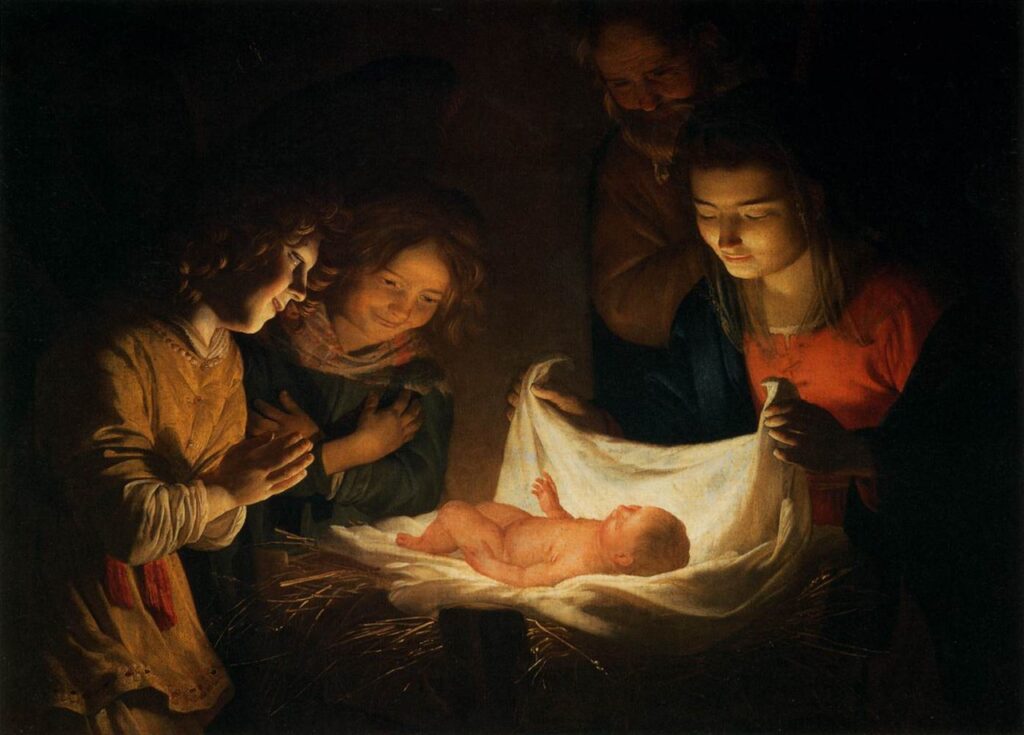
For the first Christians, however, the great feast was not Christmas but Easter, the resurrection. The birth of Jesus was not marked with any fixed celebration for a long time. Only in the 4th century, after Christianity gained legal standing in the Roman Empire, did a feast of the Nativity take hold and spread, first in the West and then more widely. The word Christmas itself comes much later, from the Old English Crīstesmæsse, meaning “Christ’s Mass,” the church service held to mark the birth.
Two related feasts framed the season. Epiphany on January 6 marked the visit of the Magi and, in the East, the baptism of Jesus. The stretch between December 25 and Epiphany became the famous Twelve Days of Christmas. To this day, churches that follow the older Julian calendar, including several Orthodox traditions, celebrate the Nativity on January 7 by the modern Gregorian calendar.
From Saint Nicholas to Santa Claus
Santa Claus has a real historical ancestor. He was Saint Nicholas of Myra, a Christian bishop who lived in the 4th century in the town of Myra, in what is now Turkey. Very little about his life is documented with certainty, but he became one of the most popular saints in all of Christianity, honored in both East and West. His feast day is December 6.
Nicholas earned a lasting reputation for secret generosity. The best known legend tells of a poor man with three daughters who had no money for their dowries. According to the story, Nicholas tossed bags of gold through the window at night, saving the daughters from ruin. Tales like this made him the patron of children and of gift giving, and they planted the seed of a gift bringer who comes in secret.
The path from a Greek bishop to the modern Santa runs through the Netherlands. Dutch tradition kept the saint alive as Sinterklaas, a dignified figure who brings gifts to children around his feast day in early December. Dutch settlers brought that figure to America, and the name softened into Santa Claus. The handover was not quite so tidy, though. Early 1800s New York writers, Washington Irving among them, deliberately revived and reshaped the old Dutch St. Nicholas, and the English Father Christmas fed into the mix as well. From these threads the old bishop began a striking transformation.
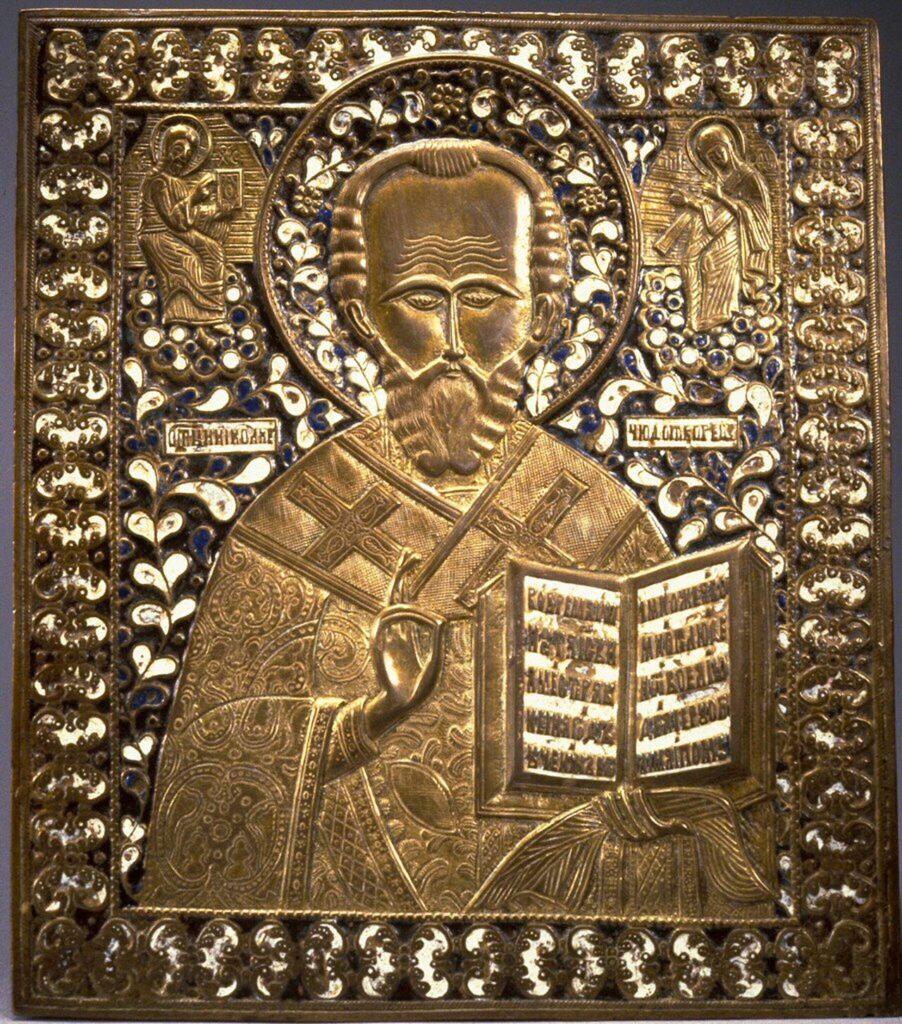
We will follow the rest of that change, the sleigh, the reindeer, and the red suit, a little later. The key point is that Santa is not a modern invention from nothing. He is a folk memory of a real saint, reshaped by centuries of storytelling.
Christmas in the Middle Ages
Through the medieval centuries, Christmas settled into the European calendar as a major feast and a long holiday. It was deeply religious, centered on church services and the Nativity, yet it was also a time of considerable merrymaking. The Twelve Days of Christmas were filled with feasting, music, games, and hospitality. For many laborers it was one of the few extended breaks from work in the whole year.
Some of the older festive spirit survived in new forms. Communities chose a Lord of Misrule to preside over the holiday’s revels, echoing the mock kings of Saturnalia. Carols developed as popular songs of the season. Households decked their halls with evergreens, holly, and ivy. The medieval Christmas was loud, communal, and unmistakably a winter feast, with the sacred and the festive sitting side by side.
When Christmas was banned
Not everyone approved. As the Reformation reshaped European Christianity, some Protestant reformers grew deeply uneasy about Christmas. They could find no scriptural command to keep it, they disliked its link to older pagan festivals, and they were appalled by its drinking and disorder. To the strictest reformers, Christmas looked less like a holy day and more like an excuse for excess.
In England this disapproval became law. During the Puritan ascendancy, Parliament banned Christmas celebrations in 1647. Shops were ordered to stay open, church services for the day were forbidden, and festive observance was suppressed. The ban was unpopular. It even sparked pro Christmas riots in some towns. Christmas returned with the monarchy in 1660, but the holiday had taken a real blow.
The Puritans carried their views across the ocean too. In the Massachusetts Bay Colony, Christmas was outlawed from 1659 to 1681, with a fine for anyone caught keeping it. For decades, in parts of New England, December 25 was just another working day. This is one reason Christmas took time to become the unifying American festival it is now. It had to live down a Puritan suspicion that ran deep.
The Victorian revival
By the early 1800s, Christmas in the English speaking world had faded. The old communal feasts had weakened, and in a fast industrializing Britain the holiday was a modest affair for many. Then, in a remarkably short span, Christmas was reinvented. Much of what we now think of as traditional comes from this Victorian burst of energy.
Three developments stand out.
The Christmas tree
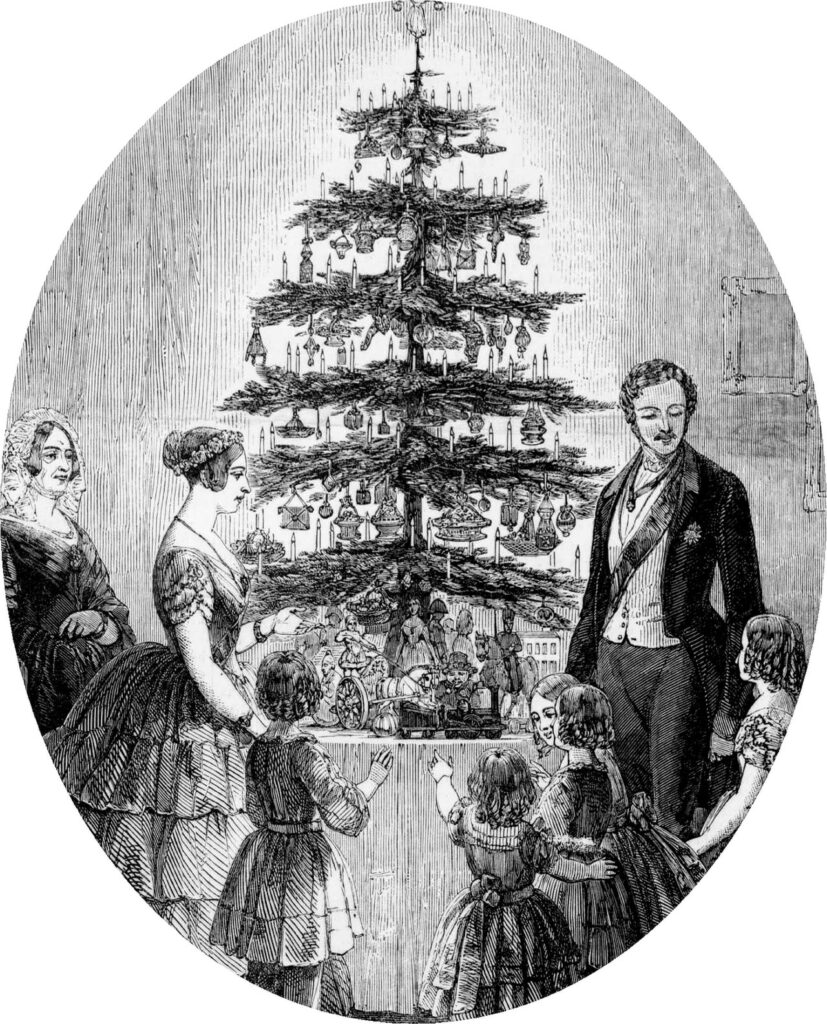
The decorated evergreen tree was a German tradition, documented in the Rhineland by the 1500s and well established across Germany by the 1700s. German royalty helped carry it to Britain. Queen Charlotte, the German wife of George III, had a decorated tree decades earlier, but the custom truly caught fire under the next generation. In 1848 an illustration of Queen Victoria, her German born husband Prince Albert, and their children gathered around a decorated tree appeared in the Illustrated London News. The image was hugely influential. A fashionable public copied the royal family, and the Christmas tree spread quickly through Britain and then America. So Albert and Victoria did not introduce the tree to Britain. They made it irresistible.
A Christmas Carol
In 1843 Charles Dickens published A Christmas Carol. Its story of Ebenezer Scrooge, the miser redeemed by the spirits of Christmas, was an instant sensation and has never gone out of print. The book did more than entertain. It fixed an image of Christmas as a time of family warmth, generosity to the poor, and goodwill. Dickens helped shift the holiday toward charity and home, and his vision of a heartfelt, sociable Christmas shaped how the Victorians, and we, imagine the season.
The Christmas card
Also in 1843, an English civil servant named Sir Henry Cole commissioned the first commercial Christmas card. Designed by the artist John Callcott Horsley, it showed a family raising a toast, with scenes of charity beside them. The idea caught on as printing grew cheaper and the postal service expanded. Within a few decades, sending Christmas cards had become a beloved ritual across Britain and beyond.
Add it up and the 1840s were extraordinary. In barely a few years the modern Christmas tree, the modern Christmas story, and the Christmas card all entered popular life. The Victorians did not invent Christmas, but they very much reinvented it, turning it into the cozy, family centered, gift giving festival we recognize today.
How Santa got his look
Across the Atlantic, the figure of Santa Claus was taking on his now familiar form, and again it happened fast. In 1823 a poem appeared anonymously in a New York newspaper, “A Visit from St. Nicholas,” better known by its first line, “‘Twas the night before Christmas.” Usually credited to Clement Clarke Moore, though some scholars argue the real author was Henry Livingston Jr., it gave us a jolly, plump, pipe smoking gift bringer who arrives on Christmas Eve in a sleigh pulled by eight named reindeer and comes down the chimney. Much of the modern Santa routine is right there in those verses.
The look was sealed by an artist. From the 1860s onward, the cartoonist Thomas Nast drew Santa for Harper’s Weekly in America. Over years of illustrations he built up the image of a round, white bearded, fur trimmed, thoroughly jolly Santa, gave him a workshop at the North Pole, and showed him keeping his list of children. By the late 1800s the modern Santa was essentially complete in the popular imagination.
This brings us to a stubborn myth. Many people believe Coca-Cola invented the red suited Santa in the 1930s. It is not true. Coca-Cola did run famous and influential advertisements from 1931, painted by Haddon Sundblom, that showed a warm, red clad, friendly Santa, and those ads helped standardize the image worldwide. But Santa was already commonly shown in red well before then. Nast and other illustrators had dressed him in red, and red suited Santas appeared in print and advertising for decades before Coca-Cola. The company popularized the look. It did not create it.
Christmas becomes a global holiday
Through the 19th and 20th centuries, Christmas spread far beyond its European and Christian heartlands. In the United States, after the Puritan chill had long passed, Christmas became a federal holiday in 1870. European empires, traders, and missionaries carried the holiday around the world, where it met and mixed with local cultures. The result was not one Christmas but many.
In the Philippines, Christmas runs for months and fills the streets with star shaped parol lanterns. In Mexico, families reenact the search for shelter in the Las Posadas processions. In Japan, where Christians are a small minority, Christmas became a bright, romantic, commercial season, complete with a famous tradition of eating fried chicken. In the Southern Hemisphere, Christmas falls in summer, so Australians may celebrate with a beach barbecue under the sun. The holiday kept its core of light, generosity, and gathering, while taking on a different face in every land. For a country by country tour of these customs, see our main guide to Christmas around the world.
Today Christmas is a public holiday in more than 160 countries and is marked, in some form, by people of many faiths and none. It is at once a Christian feast of the Nativity and a global midwinter celebration of family and goodwill. Both are real. Both grew from the long history traced here.
A short timeline of Christmas history
| Period | What happened |
|---|---|
| Ancient Rome | Saturnalia (from Dec 17) brings feasting, greenery, and gift giving to midwinter. |
| Northern Europe | Yule celebrates the solstice with the Yule log, evergreens, and feasting. |
| AD 274 | Emperor Aurelian promotes Sol Invictus, the festival of the Unconquered Sun. |
| 4th century | St. Nicholas of Myra lives and becomes famed for secret gift giving. |
| By AD 336 | The earliest recorded celebration of Christ’s birth on December 25, in Rome. |
| Middle Ages | Christmas becomes a major feast and a long, festive holiday across Europe. |
| 1647 | The Puritan led Parliament bans Christmas in England. |
| 1659 to 1681 | Christmas is outlawed in the Massachusetts Bay Colony. |
| 1823 | “A Visit from St. Nicholas” shapes the modern Santa, sleigh, and reindeer. |
| 1843 | Dickens publishes A Christmas Carol; the first Christmas card is sent. |
| 1848 | The royal Christmas tree appears in the Illustrated London News. |
| 1860s onward | Thomas Nast draws the modern Santa for an American audience. |
| 1870 | Christmas becomes a federal holiday in the United States. |
| 1931 | Coca-Cola’s ads popularize, but do not invent, the red suited Santa. |
Frequently asked questions about the history of Christmas
Why is Christmas celebrated on December 25?
The Bible does not give a birth date for Jesus. December 25 took hold in the 4th century. It may have been chosen to align the Nativity with existing Roman sun and solstice festivals, or it may come from an early Christian calculation that placed the conception on March 25 and counted nine months forward. Both explanations are taken seriously by historians, and both may have played a role.
Was Christmas originally a pagan holiday?
It is more accurate to say Christmas grew up alongside older midwinter festivals such as Saturnalia and Yule, and absorbed some of their customs, like feasting, greenery, candles, and gift giving. But the feast itself celebrates the Christian Nativity, and its December date may owe as much to early Christian reasoning as to any pagan festival. Calling it simply “a pagan holiday” oversimplifies a layered history.
Who was the original Santa Claus?
Santa Claus descends from Saint Nicholas of Myra, a 4th century Christian bishop in what is now Turkey, famous for secret gift giving. Dutch tradition kept him alive as Sinterklaas, and Dutch settlers brought that figure to America, where the name became Santa Claus and the character was reshaped over the 1800s.
Did Coca-Cola invent the red suited Santa?
No. Coca-Cola’s advertisements from 1931 helped standardize and spread the image of a jolly, red clad Santa, but red suited Santas appeared in print decades earlier, including in the work of Thomas Nast. Coca-Cola popularized the look rather than creating it.
Why was Christmas once banned?
Strict Protestant reformers objected to Christmas because it had no clear scriptural basis, was linked to pagan festivals, and was associated with heavy drinking and disorder. The Puritan led Parliament banned it in England in 1647, and it was outlawed in the Massachusetts Bay Colony from 1659 to 1681.
When did Christmas become the holiday we know today?
Much of the modern Christmas was shaped in the 1800s. The 1820s gave us the modern image of Santa, and the 1840s brought the popular Christmas tree, the Christmas card, and Dickens’s A Christmas Carol, which together turned Christmas into the family centered, gift giving festival we recognize now.
Want the highlights at a glance? See our 50 fascinating Christmas facts and trivia.