Christmas in Sweden is a festival of light in the heart of the darkness. In December the sun barely climbs above the horizon, and much of the country spends the holiday in a deep blue twilight. Against that darkness Swedes set a thousand small flames: Advent candles in every window, the glowing crown of Saint Lucia, and the warm lamps of the julbord. The Swedish word for Christmas is jul, an old term that predates Christianity itself, and the season carries that ancient, midwinter feeling.
This guide walks through the customs that shape a Swedish Christmas: the candlelit Lucia procession, the long buffet called the julbord, the gnome who brings the gifts, and the famously beloved Donald Duck broadcast on Christmas Eve. For the wider view, see our overview of Christmas history and traditions and how the holiday is marked in countries around the world.
Christmas Eve Is the Main Event
In Sweden the great day is not December 25 but December 24, Julafton, Christmas Eve. This is when families gather, eat the main feast, and open their presents. To wish someone a merry Christmas, Swedes say God Jul. December 25 and 26 follow as quieter public holidays, days for church, rest, and leftovers. A few days before, families bring home the julgran, the Christmas tree, and trim it with lights, straw ornaments, and small Swedish flags, a homely touch that often surprises first time visitors.
Advent and the Festival of Light
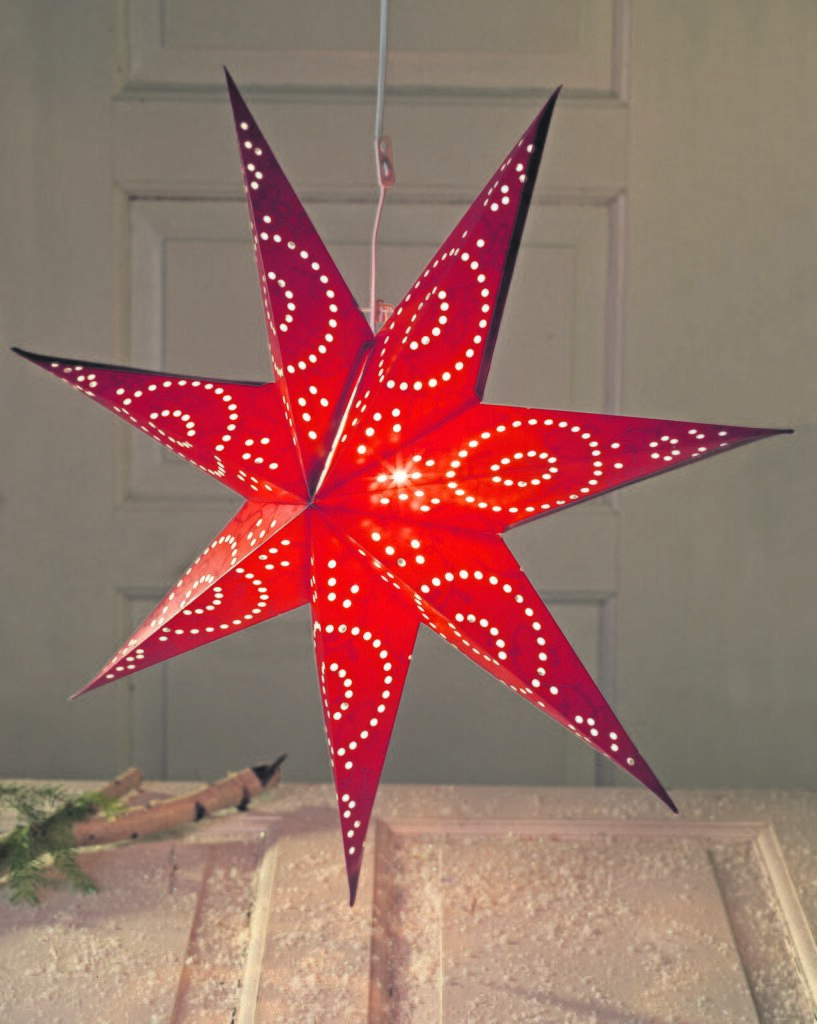
The season builds slowly through Advent, the four Sundays before Christmas. Light is the theme everywhere. Many homes light a four candle Advent candlestick, the adventsljusstake, adding one flame each Sunday, and place an illuminated star, the adventsstjärna, in the window. Electric candelabra, most of them with seven flame shaped bulbs, glow from windowsills all over the country, turning whole streets into rows of warm light. Families sing the gentle Advent carol “Nu tändas tusen juleljus,” “a thousand Christmas candles now are lit,” written by Emmy Köhler in 1898. Children count down the days with an advent calendar, a Swedish favorite since the Scouts sold the first ones in the 1930s, and with the julkalender, a television series that has aired a fresh short episode every morning of December for generations.
This love of light is no accident. Sweden sits far to the north, and around the winter solstice the days shrink to just a few hours. The candles are a gentle act of defiance against the long polar night, and they give the whole season its glow.
Saint Lucia’s Day
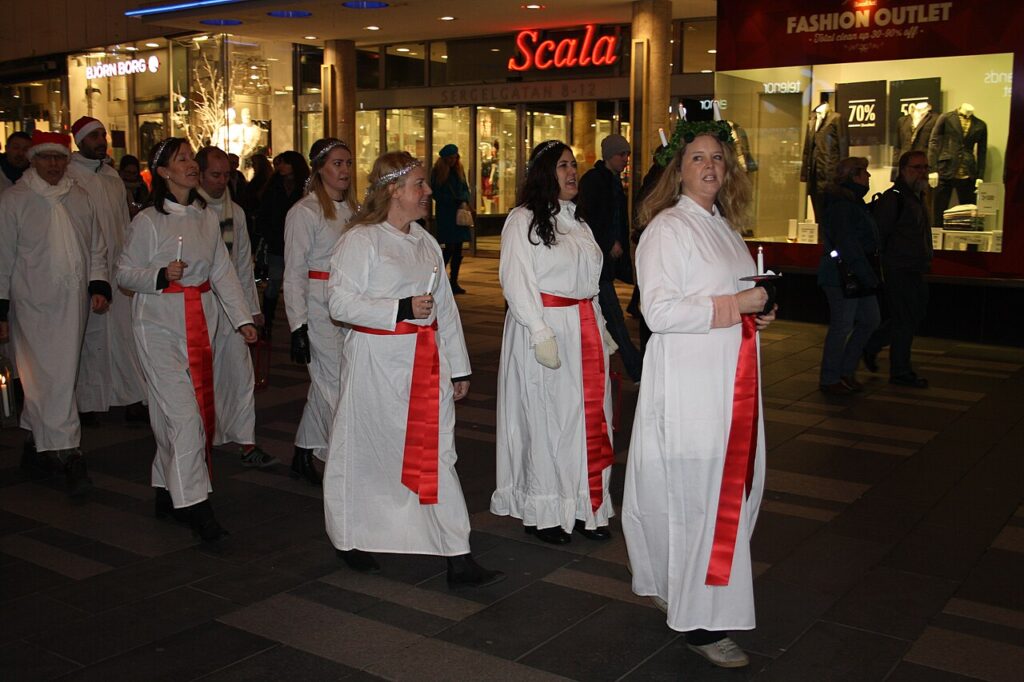
The most beautiful Swedish tradition arrives on December 13, Luciadagen, Saint Lucia’s Day. Early in the morning, schools, churches, and workplaces hold a Lucia procession. A girl chosen as Lucia leads it, dressed in a white gown and a crown of candles on her head. Behind her come attendants in white with red sashes, the tärnor, star boys called stjärngossar in tall pointed hats, and often small children dressed as gingerbread men.
The procession moves slowly through the candlelit dark, singing the haunting “Sankta Lucia” song. There is a curious twist to it all. Lucia was a Christian martyr from Sicily, in sunny southern Italy, whose name means “light.” Legend says she carried food to Christians hiding in the catacombs and wore candles on her head to keep her hands free. Her feast of light found its deepest home in the dark Swedish winter, falling on what was the longest night of the year under the old Julian calendar. The grand public processions are surprisingly modern: a Stockholm newspaper organized one of the first in 1927. Saffron buns and gingerbread are handed round afterward.
Lussekatter, Pepparkakor, and Glögg
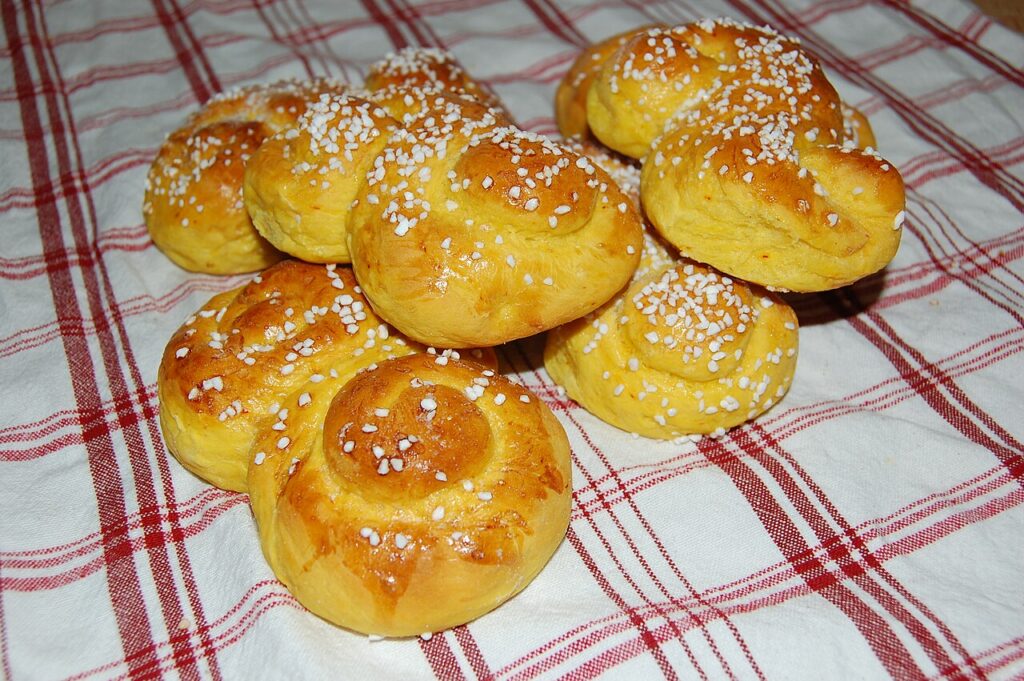
Swedish Christmas baking has its own stars. Lussekatter, the golden saffron buns shaped into a soft letter S and dotted with raisins, are tied above all to Lucia and the season around her. Pepparkakor are thin, crisp gingerbread biscuits, snapped into hearts and stars and gingerbread men, and used to build gingerbread houses.
To drink there is glögg, a hot spiced wine served with raisins and blanched almonds dropped into the cup. A mug of glögg with a few pepparkakor is the classic Swedish way to warm up on a dark December afternoon. Children and the season also have julmust, a dark, spiced soft drink that outsells cola in Sweden every December.
The Julbord: A Feast in Courses
The centerpiece of the Christmas Eve meal is the julbord, the Christmas table, a vast buffet eaten in a set order rather than all at once. Diners usually begin with fish, move on to cold cuts, then to warm dishes, and finish with sweets, returning to the table again and again.
A traditional julbord overflows with dishes:
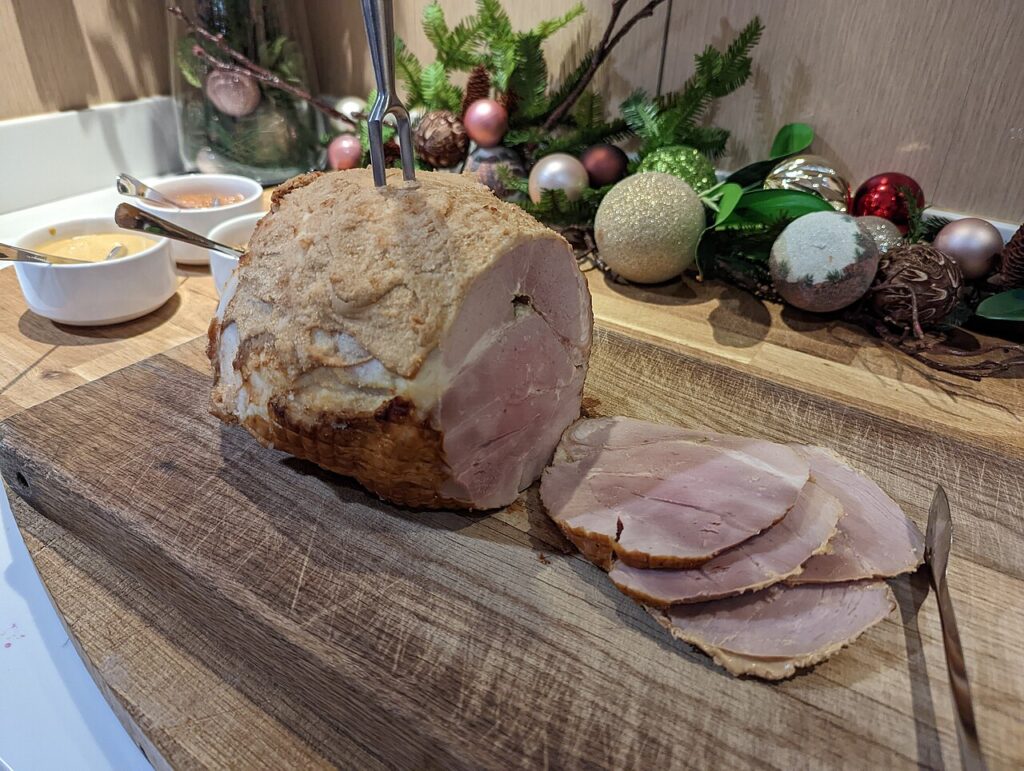
- Julskinka, the Christmas ham, glazed with mustard and breadcrumbs, the proud centerpiece.
- Several kinds of pickled herring, sill, and cured salmon, gravlax.
- Köttbullar, Swedish meatballs, and prinskorv, little sausages.
- Janssons frestelse, “Jansson’s temptation,” a creamy gratin of potato, onion, and sprats.
- Lutfisk, dried whitefish cured in lye then gently cooked, an old and acquired taste.
- Red cabbage, beetroot salad, boiled potatoes, and crispbread to tie it together.
An old custom called dopp i grytan, “dipping in the pot,” recalls leaner times, when families dipped bread into the broth left from boiling the ham. The day before Christmas Eve was once known as Dopparedagen, dipping day, in its honor.
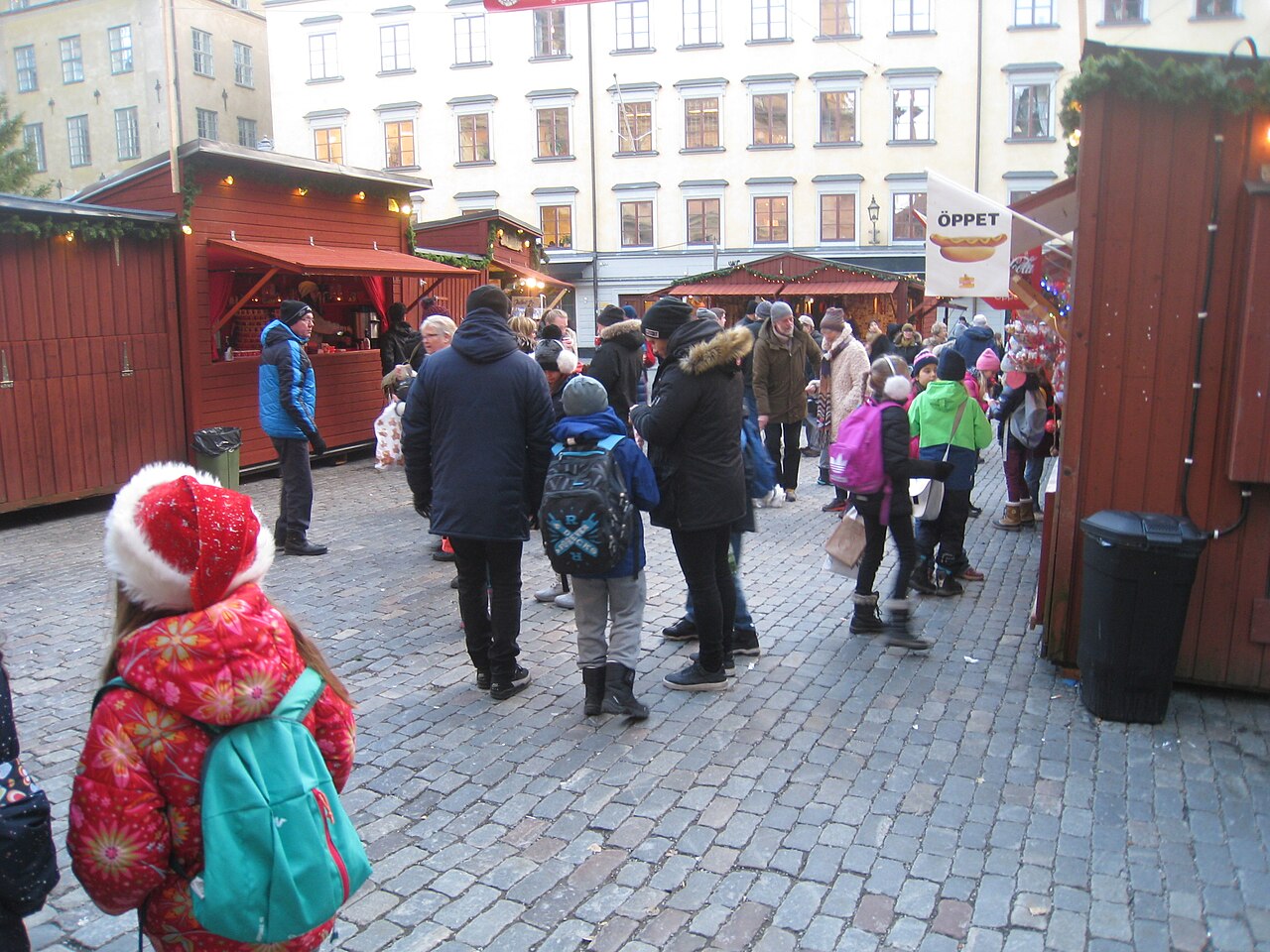
To gather the ingredients, and to soak up the atmosphere, Swedes flock to Christmas markets that fill the old town squares through December. The market at Skansen, the open air museum in Stockholm, is among the country’s oldest, and the stalls on Stortorget in the capital’s Gamla Stan are some of the most photographed, selling glögg, handicrafts, smoked sausage, and sweets from little wooden huts.
The Jultomte Brings the Gifts
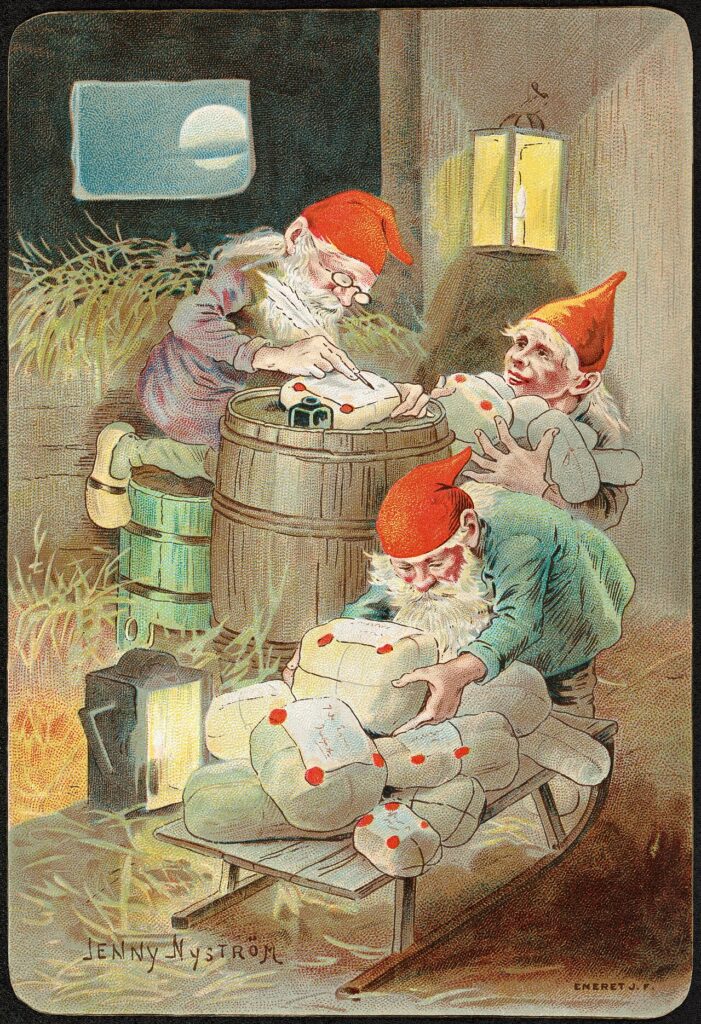
The Swedish gift bringer is the Jultomte. He grew out of the tomte or nisse of old folklore, a small, bearded gnome who was believed to live on the farm and quietly guard the family and animals, so long as he was treated with respect and left a bowl of porridge.
Over time this household spirit merged with the imported figure of Santa Claus to become the modern Jultomte. The poet Viktor Rydberg gave him a starring role in his 1881 poem “Tomten,” and the artist Jenny Nyström, in thousands of Christmas cards, fixed his red cap and kindly face in the national imagination. In a charming Swedish twist, he often arrives in person on Christmas Eve, knocking at the door with a sack of presents and asking, “Finns det några snälla barn här?”, “Are there any good children here?” More often than not, a family member has mysteriously stepped out just before he appears. Swedish gifts, julklappar, traditionally carry a little rhyme written on the label, a teasing clue to what waits inside, read aloud to the room before the wrapping comes off.
Donald Duck at Three O’Clock
One modern tradition is so fixed that Christmas Eve plans are arranged around it. At exactly 3:00 in the afternoon on December 24, millions of Swedes sit down to watch “Kalle Anka och hans vänner önskar God Jul,” a Disney cartoon compilation whose title means “Donald Duck and his friends wish you a Merry Christmas.” It has aired on national television almost every year since 1959, and it remains one of the most watched programs in the country. The clips barely change from year to year, and that is exactly the point. Interrupting it is close to forbidden.
The Gävle Goat and the Yule Goat
Long before Santa, the Scandinavian Christmas had the julbock, the Yule goat. Straw goats tied with red ribbon are still among the most typical Swedish Christmas ornaments, and in the old days it was the goat, not a jolly man in red, that was linked with bringing gifts.
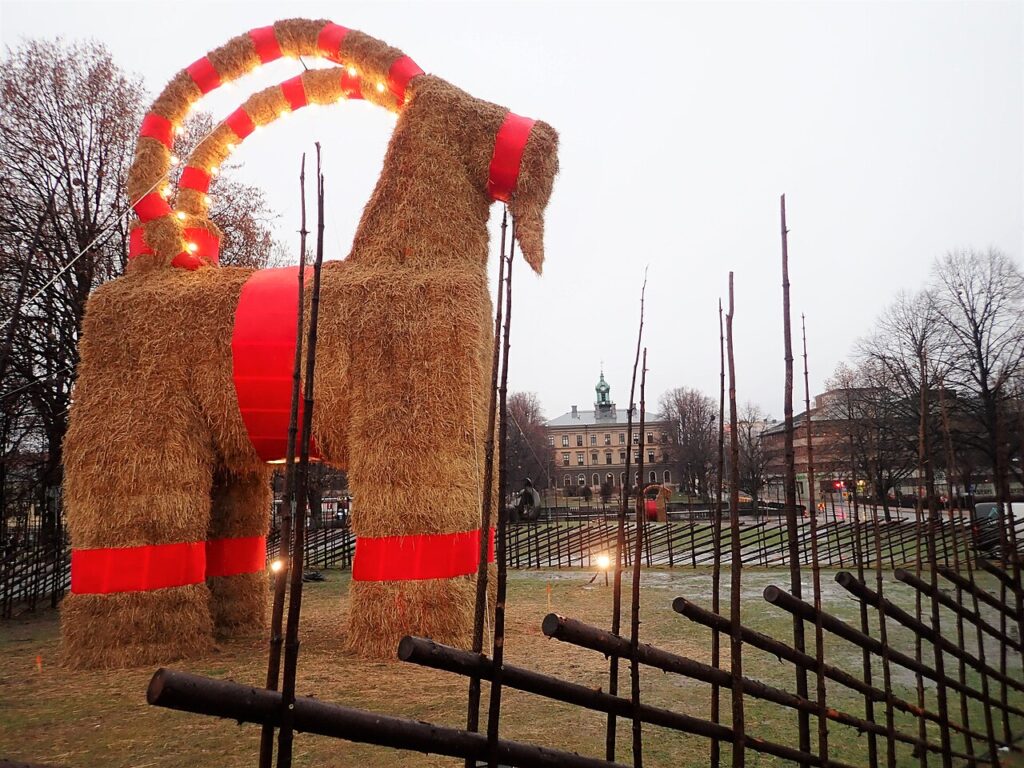
The town of Gävle has turned the symbol into a national spectacle. Since 1966 it has built a giant straw goat, the Gävlebocken, in its central square at the start of Advent. Almost as old as the tradition is the habit of vandals trying to burn it down. The goat has gone up in flames many times over the decades, and each December the country watches, half hoping it survives and half waiting to see if it will.
Until Knut’s Day
Swedish Christmas does not end with December. It runs on until January 13, Tjugondag Knut, Saint Knut’s Day, the twentieth day after Christmas. As the old saying goes, “Tjugondag Knut dansar julen ut,” twentieth day Knut dances Christmas out. On this day families hold a julgransplundring, a “plundering of the Christmas tree.” Children strip the tree of its edible decorations and sweets, there is a last dance around it, and then the tree is carried out the door.
From the first Advent candle to the last dance around the tree, Christmas in Sweden is a long, luminous answer to the winter dark. To see how other cultures celebrate, explore our guides to Christmas foods around the world and the gift bringers of many lands.