No country celebrates Christmas quite like the Philippines. Here the holiday is not a single day or even a single month. It is a season that swells through a quarter of the year, widely regarded as the longest Christmas celebration on earth. As soon as the calendar turns to September, the air shifts. Shopping malls switch on their lights, radio stations dust off familiar carols, and homes begin to glow with star shaped lanterns. By the time December arrives, the whole archipelago is wrapped in festivity.
This guide explains why Christmas runs so deep in the Philippines, and walks through the customs that make it unmistakable: the dawn Masses of Simbang Gabi, the luminous parol, the midnight feast of Noche Buena, and the food, faith, and family that hold it all together. For the wider picture, see our overview of Christmas history and traditions and how the holiday looks in countries around the world.
The Longest Christmas Season in the World
Filipinos often joke that their Christmas season begins the moment the “ber months” arrive. September, October, November, and December all end in those three letters, and the first of September is the unofficial signal that the countdown has started. Carols play in shops months before December. Decorations go up early. The mood builds slowly and steadily rather than arriving all at once.
The music is part of the magic. When Filipino Christmas songs return to the radio in September, the singer Jose Mari Chan, whose 1990 album gave the country one of its best loved carols, is affectionately crowned the unofficial face of the season, his early arrival each year a cheerful national meme.
The celebration does not stop on December 25 either. It carries on through the new year and traditionally closes with the Feast of the Three Kings in early January. Stretched end to end, the season can fill four months of the calendar. Few other places sustain that kind of festive endurance, and it is a point of genuine national pride.
A Catholic Country at Heart
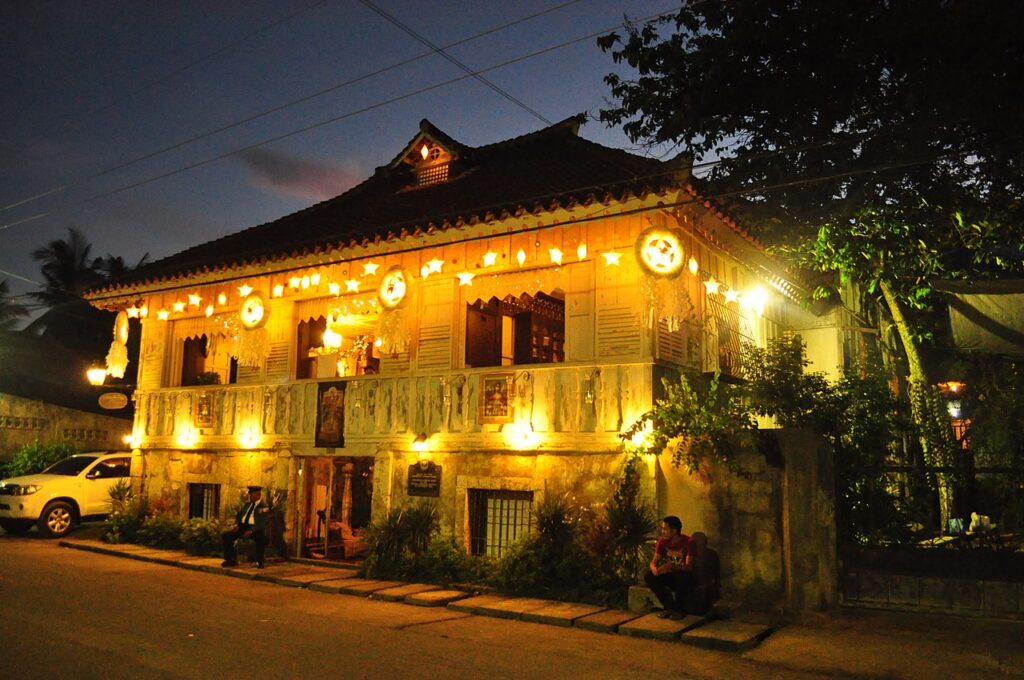
To understand why Christmas matters so much here, look to history. The Philippines spent roughly three centuries under Spanish rule, beginning in the 1500s, and Catholicism took deep root. Today it is the largest predominantly Christian nation in Asia, with the great majority of Filipinos identifying as Roman Catholic. Faith and festivity are woven together.
That heritage shows in the language. The Tagalog word for Christmas is Pasko, from the Spanish Pascua. To wish someone a merry Christmas, you say Maligayang Pasko. Many of the season’s signature customs, from the nativity scene to the dawn Masses, carry Spanish names and Spanish roots, reshaped over the centuries into something distinctly Filipino.
Simbang Gabi: Nine Dawn Masses
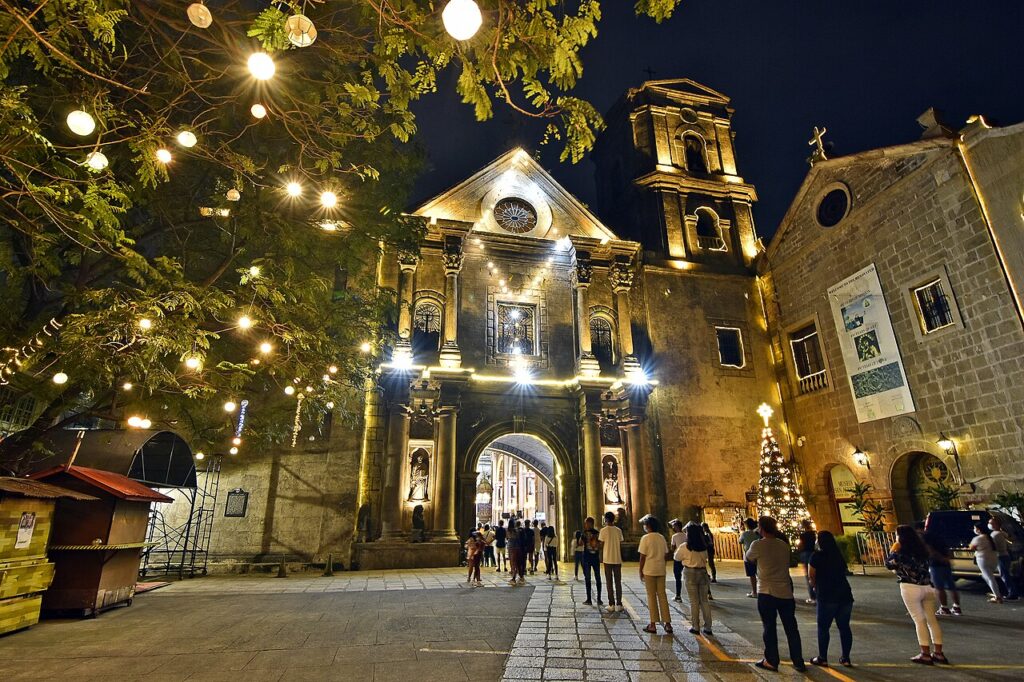
The spiritual heart of a Filipino Christmas is Simbang Gabi, also known by its Spanish name Misa de Gallo, or “Mass of the Rooster.” This is a series of nine Masses held on nine consecutive days, from December 16 through to the dawn of December 24.
The Masses are famously early. Many begin around four or five in the morning, when the streets are still dark and cool. Churches fill anyway. The tradition dates back to the Spanish colonial era, when farmers and fishermen needed to worship before a long day of work, and it has held firm for generations. The dawn services are also known as the Misa de Aguinaldo, the “gift Masses,” a name that ties them to the spirit of giving that runs through the season.
A cherished piece of folk belief says that anyone who completes all nine Masses will have a heartfelt wish granted. Whether or not the wish comes true, the commitment of waking before sunrise for nine straight days is itself an act of devotion that families undertake together.
The Parol: Star of the Filipino Christmas
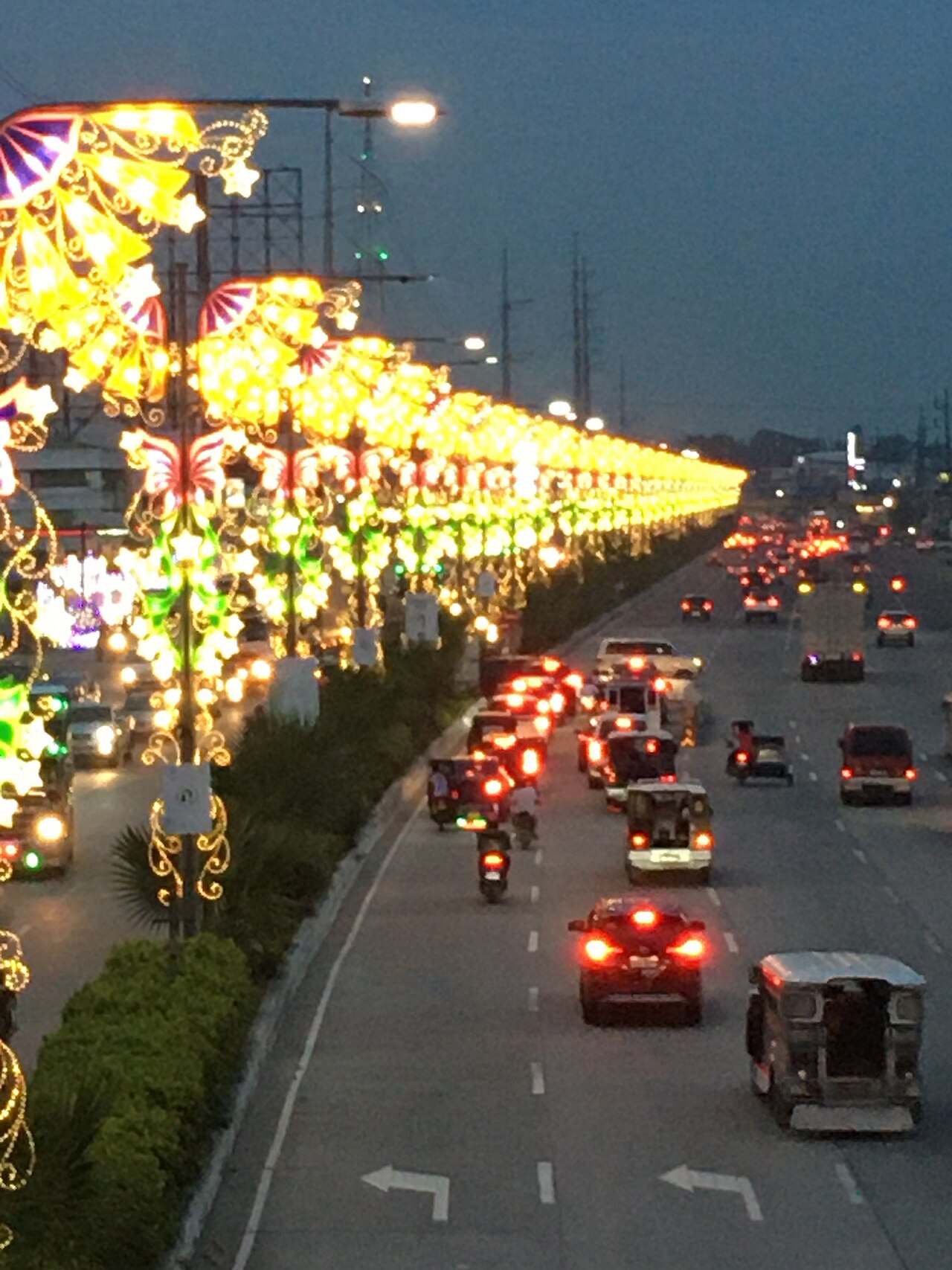
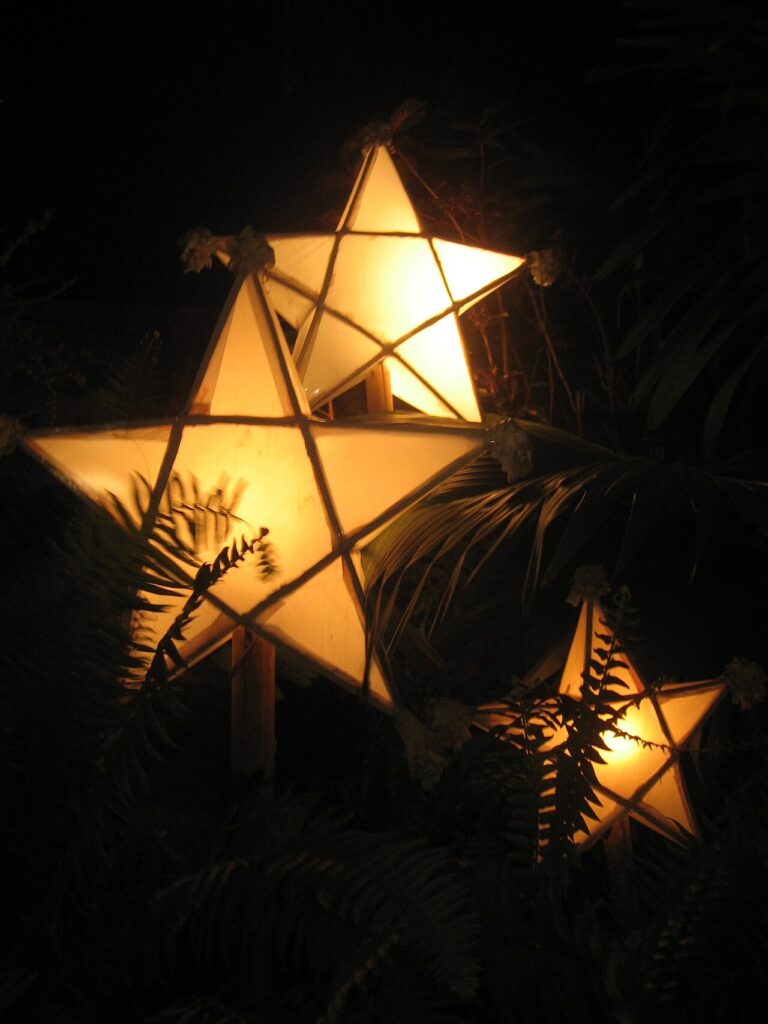
If one object captures Christmas in the Philippines, it is the parol. This is a star shaped lantern that hangs in windows, along streets, and above doorways across the country. Its name comes from the Spanish farol, meaning lantern, and its five pointed star represents the Star of Bethlehem that guided the wise men to the manger.
The classic parol is a simple, beautiful thing: a bamboo frame covered in brightly colored papel de Hapon, a thin Japanese paper, with two tails streaming from the lower points. The familiar five pointed design is often credited to Francisco Estanislao, a craftsman from Pampanga who shaped the modern parol in the early 1900s. Today’s versions can be far more elaborate, built from capiz shell or fitted with dancing electric lights, but the star at the center never changes.
Nowhere is the parol taken more seriously than in the City of San Fernando in Pampanga, known as the Christmas Capital of the Philippines. Its Giant Lantern Festival features enormous parols, some many meters across, packed with thousands of spinning, synchronized lights that pulse in time like fireworks frozen in glass. Villages compete to build the most dazzling lantern, and crowds gather to watch them blaze against the night.
Bibingka and Puto Bumbong
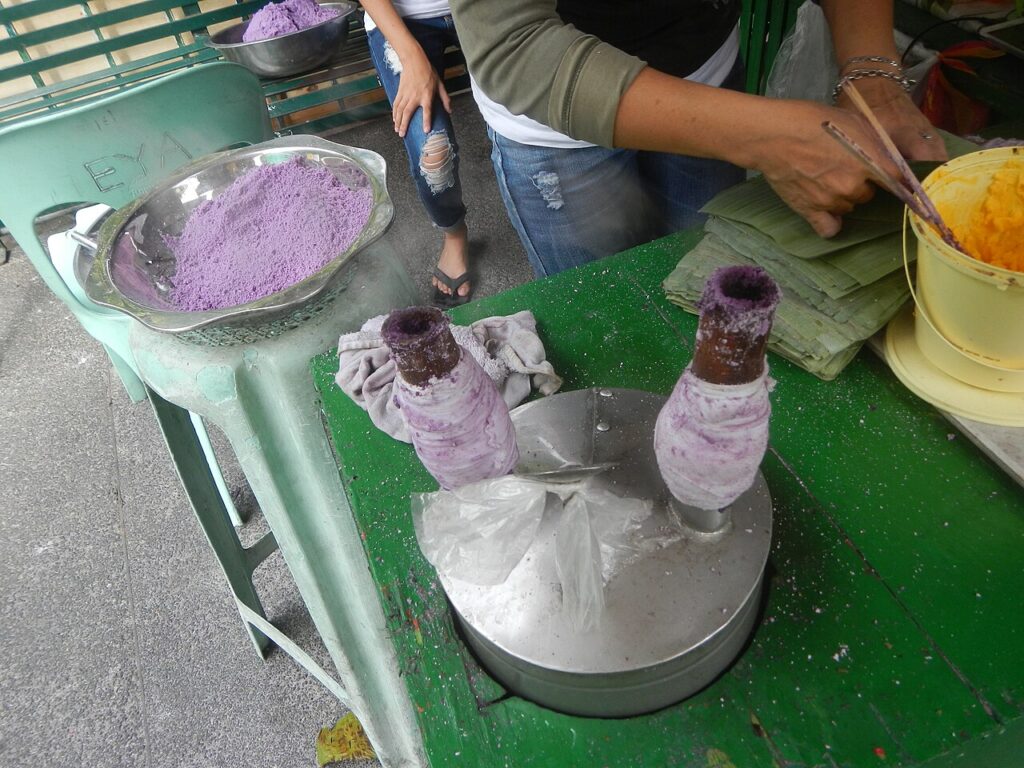
Step out of a dawn Mass and you will often find vendors waiting just outside the church, their stalls warm and fragrant. After Simbang Gabi, Filipinos traditionally gather over two beloved rice cakes that are tied to this season more than any other.
Bibingka is a soft rice cake baked in a clay pot lined with banana leaf, with glowing coals set above and below. It is often topped with salted egg, slices of cheese, and a brush of butter, then finished with grated coconut. Puto bumbong is its purple companion, a sticky violet rice steamed inside thin bamboo tubes until it forms slender cylinders, served with butter, sugar, and coconut. Eaten together in the cool morning air, they are pure Christmas comfort.
The Belen
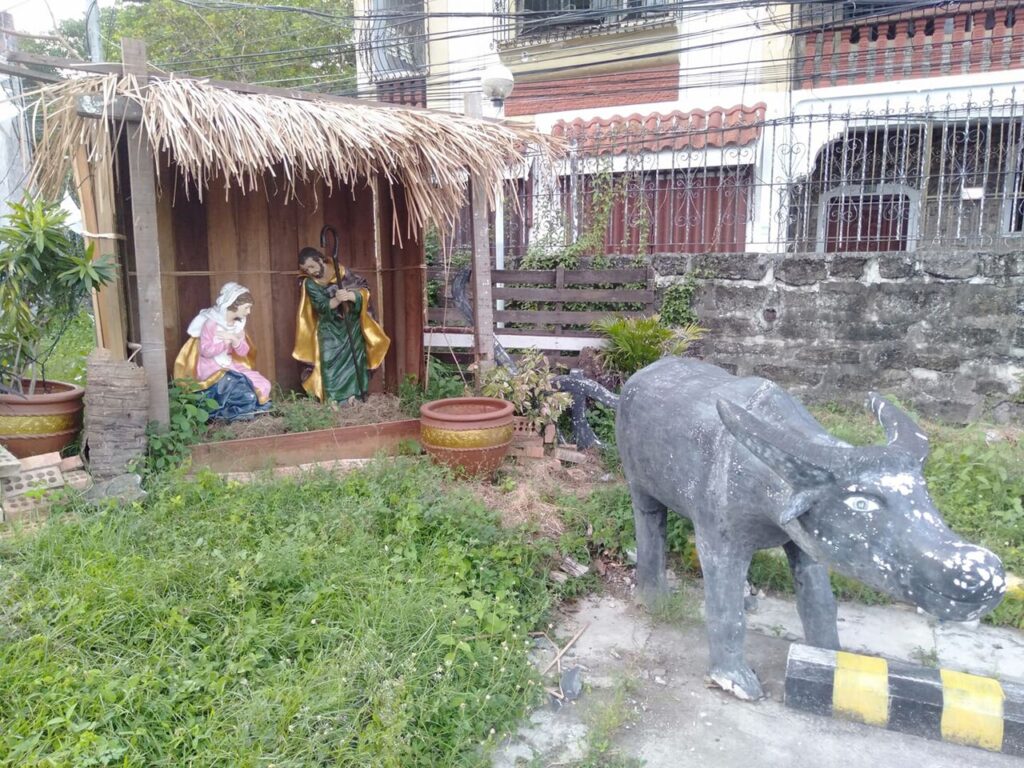
Filipino homes, churches, and town plazas display the belen, the nativity scene that recreates the birth of Christ in the stable at Bethlehem. The word again comes from Spanish, the name of the holy town itself. A belen can be a small tabletop set or a grand public tableau with life sized figures, complete with the Holy Family, shepherds, animals, angels, and the three kings.
Building and displaying the belen keeps the religious meaning of Christmas at the center of the celebration, a reminder that beneath the lights and feasting lies the story the season was built around.
Noche Buena: The Christmas Eve Feast
In many parishes Christmas Eve also brings the Panunuluyan, a candlelit reenactment of Mary and Joseph searching for a place to stay in Bethlehem. Performers move from door to door, turned away each time, until the procession reaches the church for the midnight Mass. It is the Filipino cousin of Mexico’s Las Posadas, another inheritance of shared Spanish faith.
The high point of the season arrives on the night of December 24. After attending Christmas Eve Mass, families come home to Noche Buena, a grand midnight feast whose name means “good night” or “holy night” in Spanish. The table groans with food, and the whole household, often three generations under one roof, gathers to eat, talk, and welcome Christmas Day together.
The spread is a delicious blend of native and Spanish influences. Common stars of the table include:
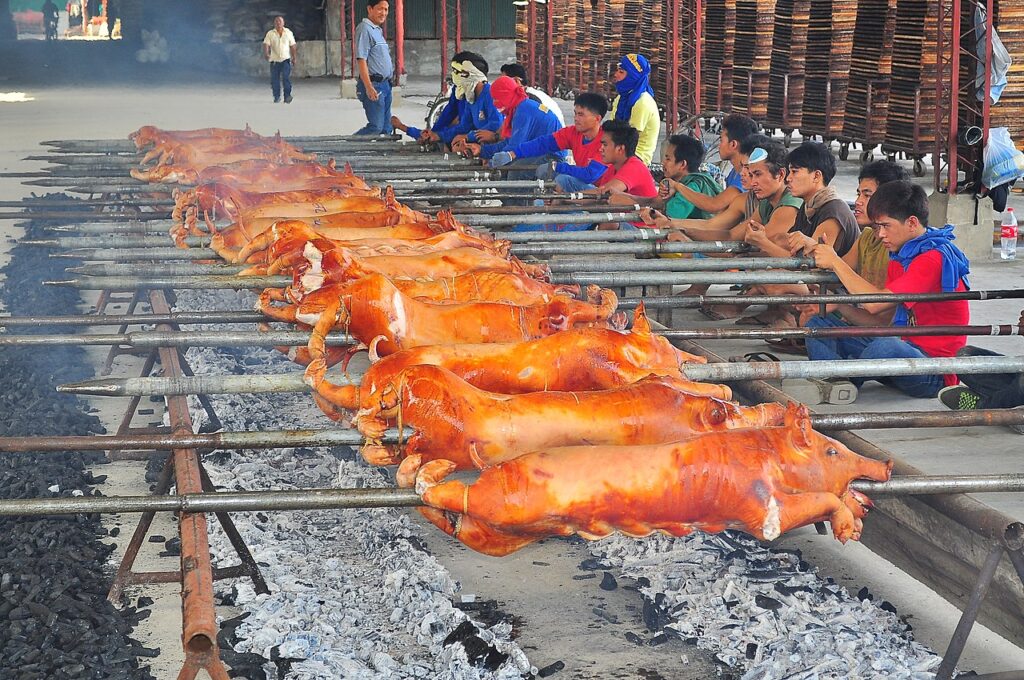
- Lechon, a whole pig roasted slowly over coals until the skin turns crisp and golden, the centerpiece of any major Filipino celebration.
- Hamon, a sweet glazed Christmas ham, often cured and studded with cloves.
- Queso de bola, a round ball of Edam cheese in its signature red wax, paired with the ham.
- Pancit noodles for long life, fresh and fried lumpia spring rolls, and a sweet, creamy fruit salad made with canned fruit and condensed milk.
There is no single fixed menu. Every family has its own treasured combination, passed down and defended with pride.
Christmas Day, Gifts, and Godparents
On Christmas Day itself, the focus is family and the youngest members of it. Children visit their ninong and ninang, their godfathers and godmothers, who hold a place of real importance in Filipino life. From godparents and elders the children receive aguinaldo, a gift of money or presents given at Christmas.
In return, children show respect with the gesture of mano po, gently taking an elder’s hand and pressing the back of it to their own forehead. It is a small, graceful act that runs through Filipino culture year round and takes on extra warmth at Christmas. Visiting relatives, sharing food, and reconnecting with extended family fill the day.
Caroling and the Sound of the Season
Long before December, the music begins. Filipino Christmas songs return to the airwaves in September, and one singer in particular has become so linked with the season that his early arrival each year is a running national joke and a sign that Christmas is truly coming.
Caroling is a hands on tradition too. Groups of children go house to house singing, a custom called namamasko, sometimes armed with homemade instruments fashioned from bottle caps strung on wire. In exchange for a song they hope for a few coins or a small treat, then move on to the next door with a cheerful “thank you” and a wish for a merry Christmas.
How the Season Ends
The long celebration does not rush to a close. The Christmas tree and the parol stay up well into January. The traditional ending is the Feast of the Three Kings, the Epiphany, which in the Philippines is now observed on the first Sunday of the new year. It marks the arrival of the wise men at the manger and brings the season to its gentle, faithful end. For many Filipinos, especially in Cebu, the festivities stretch even further to the Feast of the Santo Niño, the Holy Child, on the third Sunday of January, celebrated with the famous Sinulog procession.
From the first carol in September to the last lantern taken down in January, Christmas in the Philippines is a marathon of faith, food, and family. It is loud and bright and deeply rooted, a celebration that turns an entire nation luminous for months on end. To see how other cultures mark the holiday, explore our guide to Christmas foods around the world and the gift bringers of many lands.