Few countries have shaped the way the world celebrates Christmas as much as Germany. The decorated tree, the Advent wreath, the Advent calendar, glass ornaments, and the gingerbread house all began here, then spread across the globe. To spend Christmas in Germany is to visit the source of so many familiar customs.
Yet a German Christmas is also distinctly its own. It runs on a four week rhythm of Advent, peaks on Christmas Eve rather than Christmas morning, and fills its town squares with some of the oldest and most beautiful markets on earth. This guide walks through the German Christmas season, from the first candle of Advent to the roast goose on the table.
For how Germany fits into the wider picture, see our guide to Christmas around the world, or the full guide to Christmas.
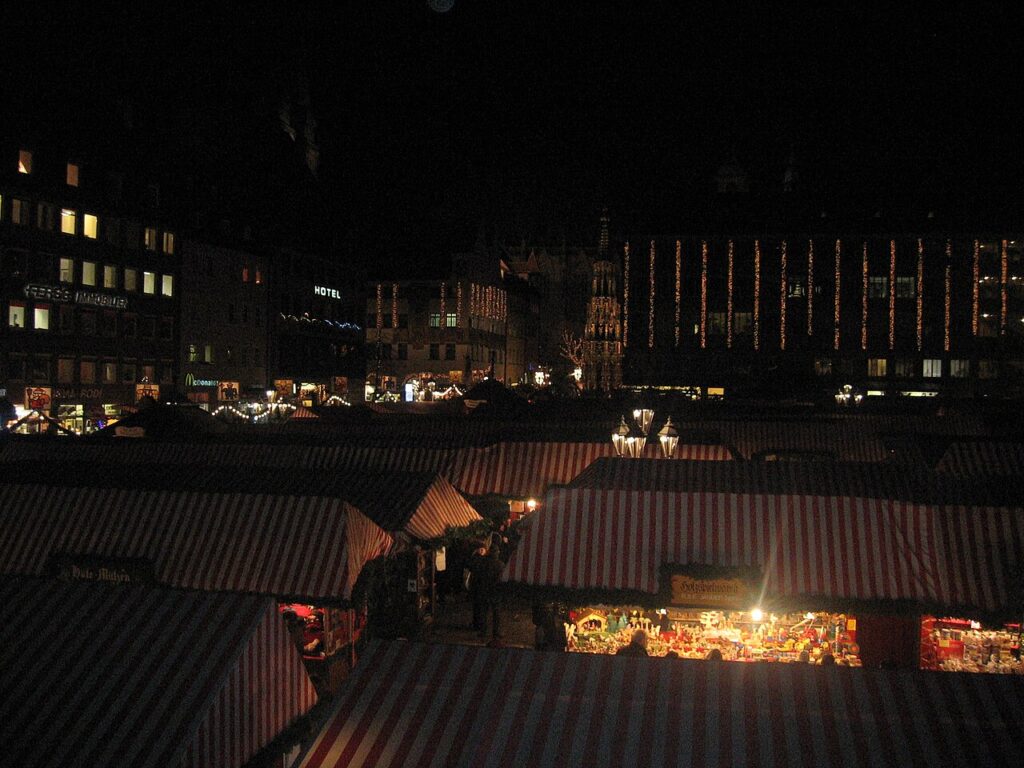
The Christmas Markets
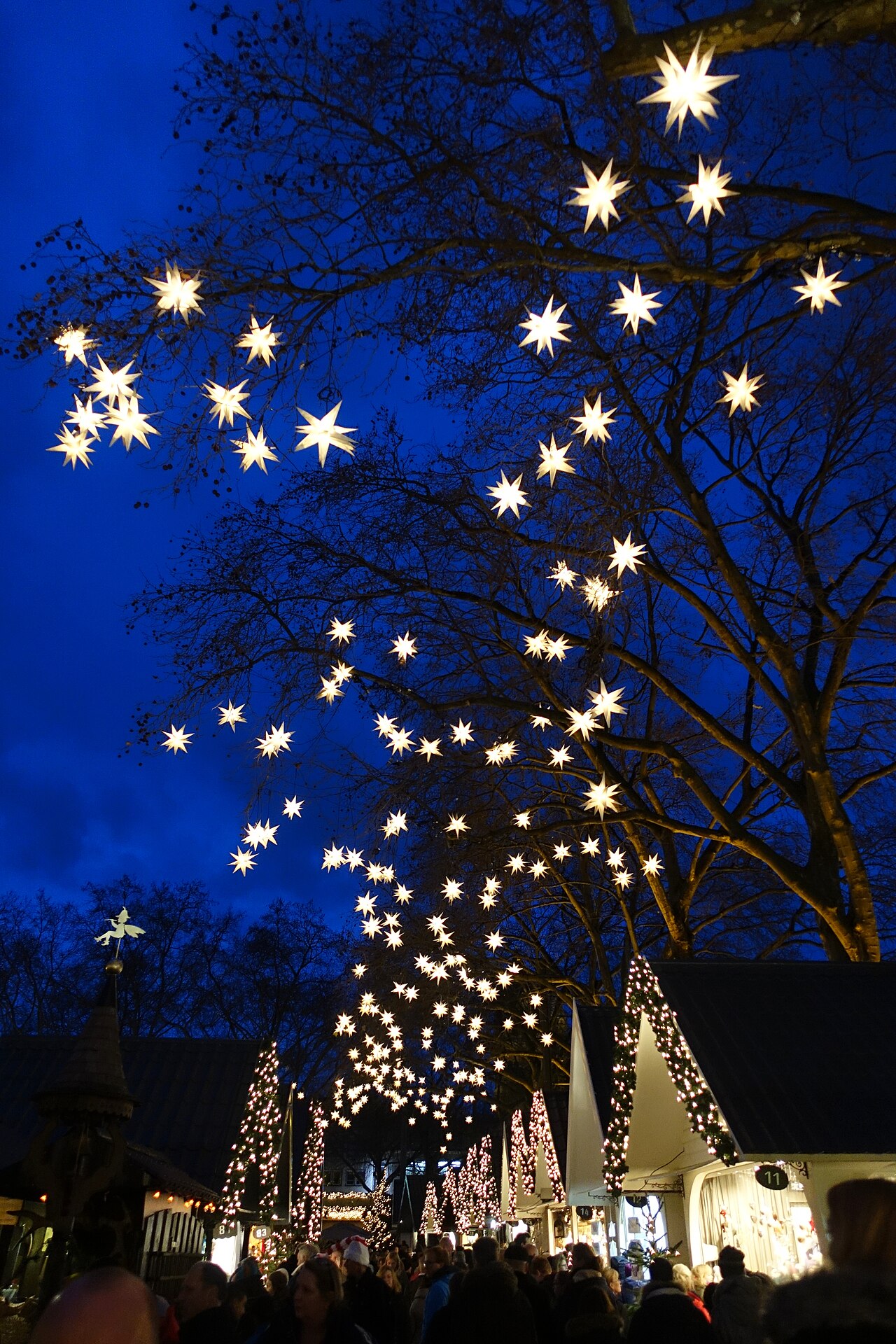
Nothing says a German Christmas like the Weihnachtsmarkt. From late November, town squares across the country fill with wooden chalets selling mulled wine, roasted almonds, handmade ornaments, and hot food, all under strings of lights and the sound of carols. Wandering a market with a warm mug in hand is the heart of the season.
The markets are old. Dresden’s Striezelmarkt, first held in 1434, is one of the oldest documented Christmas markets in Germany, named after the stollen, or Striezel, sold there. Nuremberg’s Christkindlesmarkt is perhaps the most famous of all, drawing around two million visitors a year to the city’s medieval square. By tradition it is opened by the Christkind, a young woman robed in gold and white, who recites a prologue from the gallery of the Frauenkirche. In Cologne, the great market spreads out beneath the twin spires of the cathedral.
The drink of the markets is Glühwein, red wine warmed with cinnamon, cloves, and orange, served in a collectible mug. Alongside it come grilled sausages, sugared roasted almonds, and gingerbread hearts iced with messages. Each region adds its own specialty, but the warmth and the glow are the same everywhere.
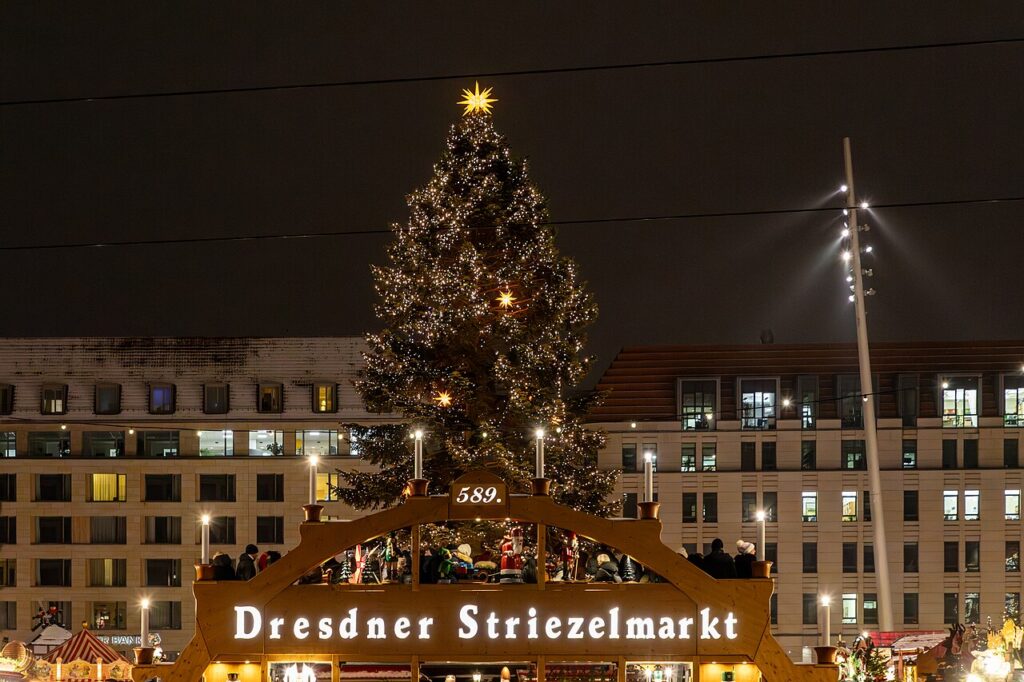
The markets are as much about food as gifts. Beyond the Glühwein, stalls sell Bratwurst in a crusty roll, Reibekuchen, crisp potato pancakes with apple sauce, hot roasted chestnuts, and Feuerzangenbowle, a dramatic punch made by setting a rum soaked sugar loaf alight over mulled wine. The crafts on the stalls, hand carved figures, blown glass baubles, candles, and beeswax ornaments, are often made in the same region by families who have done so for generations. A German market is a feast for every sense at once.
The Season of Advent
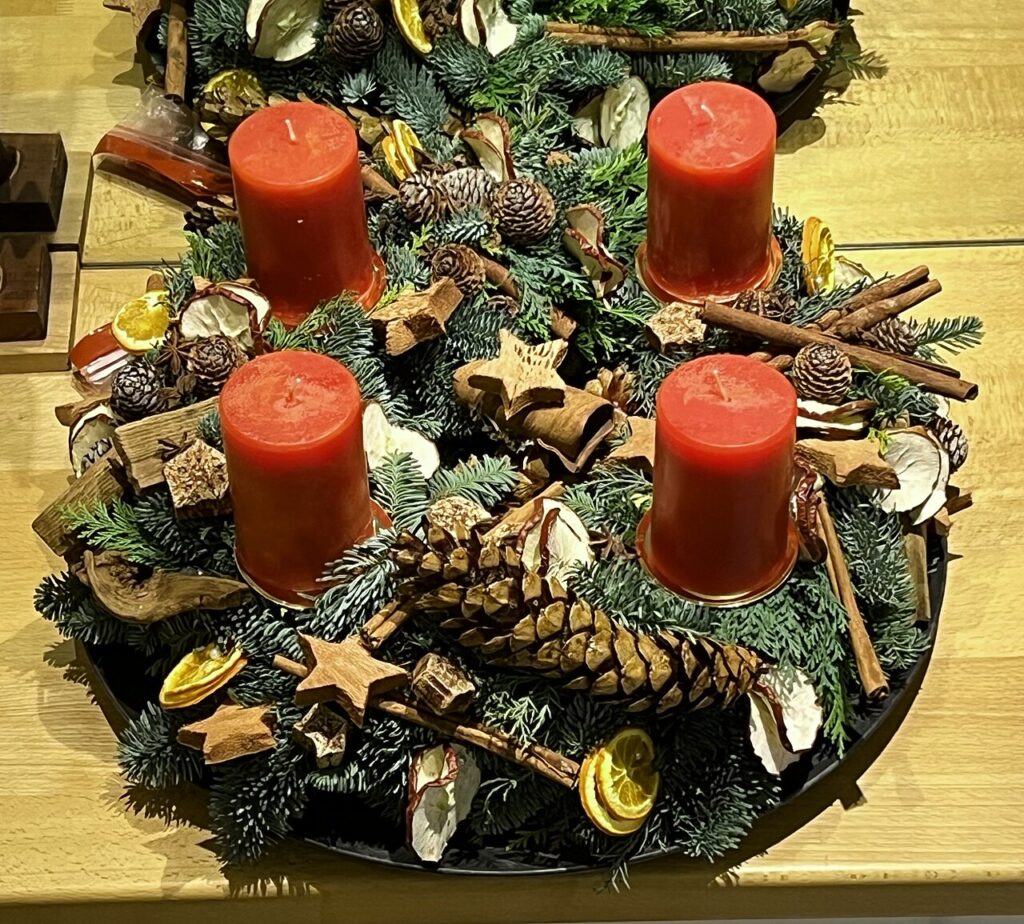
For Germans, Christmas does not arrive all at once. It is preceded by the four weeks of Advent, and the country gave the world two of the season’s best loved countdowns.
The Advent wreath, or Adventskranz, is a ring of evergreen holding four candles, one lit on each Sunday of Advent so the light grows week by week. It was the idea of a Protestant pastor named Johann Hinrich Wichern, who built the first one in Hamburg in 1839 to help the children in his care count down to Christmas. Families gather around the wreath each Advent Sunday, often with cookies and carols.
The Advent calendar is also a German invention, born among Lutherans in the 1800s, with the first printed calendars appearing in the early 1900s. Behind each of its twenty four doors waits a small picture, a chocolate, or a treat. Both customs share the same gentle purpose: to stretch out the joy of waiting and to mark the slow approach of Christmas Eve.
Other Advent customs fill out the season. On December 4, Saint Barbara’s Day, some families cut a few cherry branches, the Barbarazweig, and keep them in water indoors, hoping they will blossom by Christmas as a sign of good luck for the year. Through the four weeks, choirs and brass bands perform at Adventssingen concerts, and Bach’s Christmas Oratorio rings out in churches across the country.
The Christmas Tree
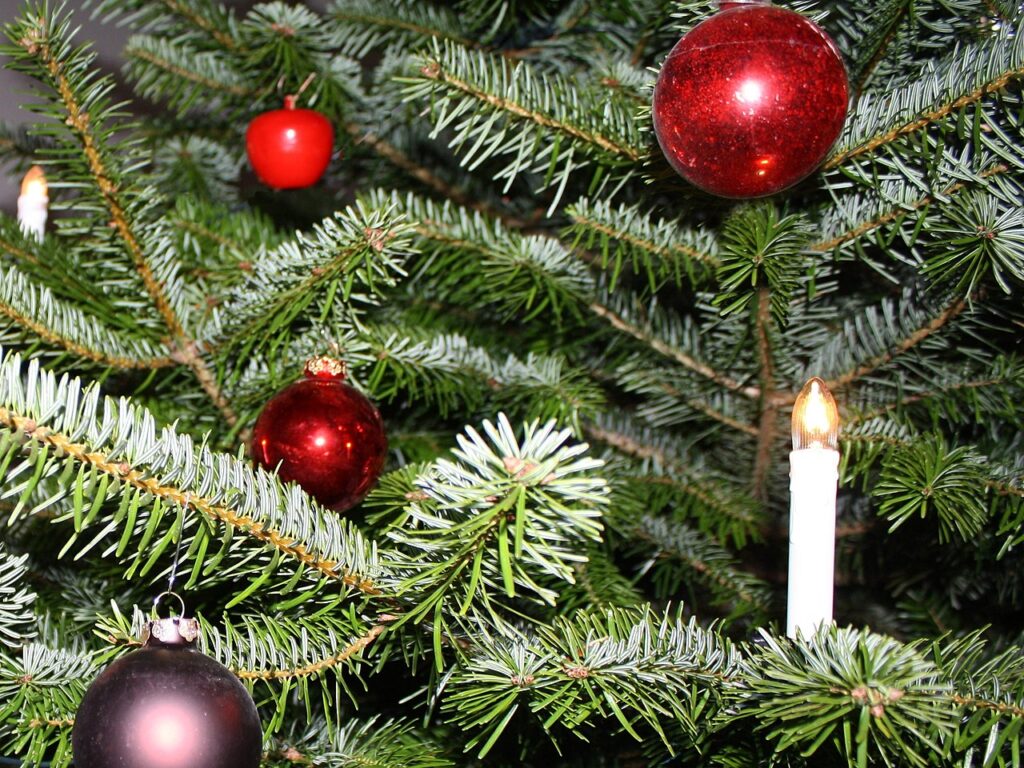
The Christmas tree is Germany’s greatest gift to the world’s Christmas. German families were bringing evergreens indoors and decorating them with apples, nuts, and candles as far back as the 1500s, and the custom spread from here to Britain, America, and beyond. The evergreen, staying green through the dead of winter, has always stood for life that endures.
In many German homes the tree keeps a special air of mystery. It is often put up and decorated on December 24 itself, sometimes behind closed doors, and revealed to the children only on Christmas Eve, glowing with lights. That first sight of the finished tree is one of the great moments of a German Christmas. The carol “O Tannenbaum,” in praise of the fir tree’s faithful green, was born in this tradition.
Saint Nicholas Day
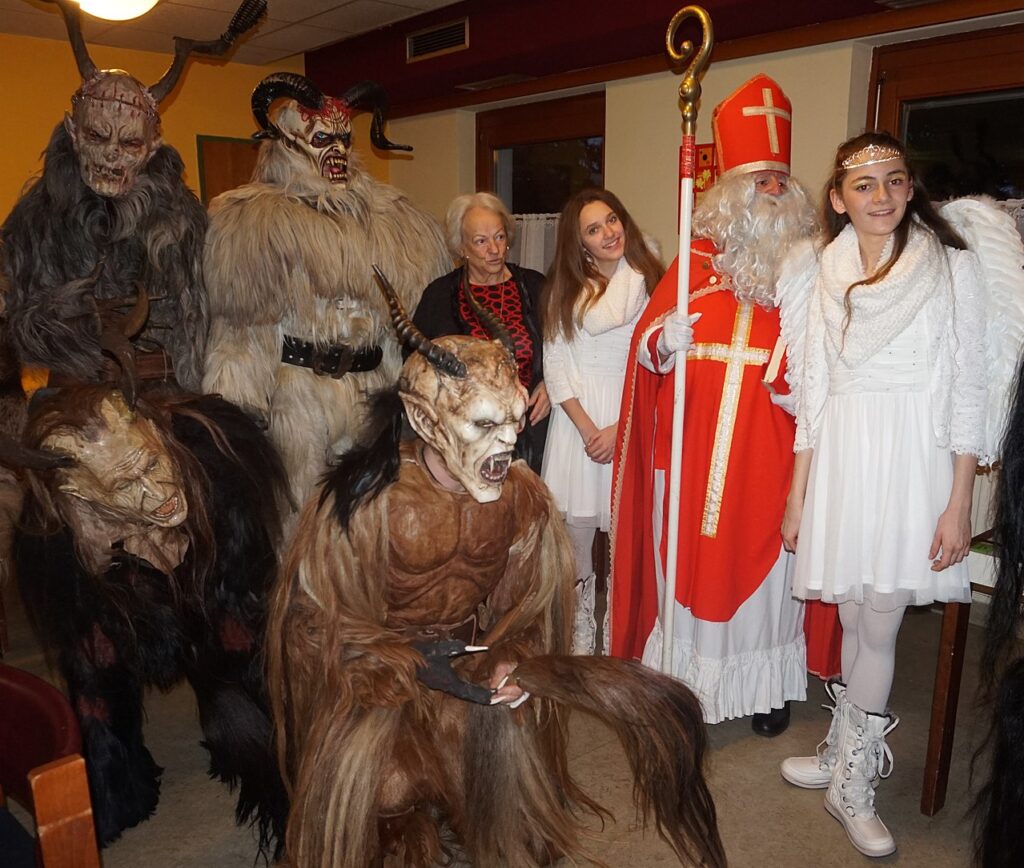
Long before Christmas Eve, German children look forward to Saint Nicholas Day on December 6. On the evening of the 5th, they clean a boot or shoe and set it by the door, and in the morning find it filled with sweets, nuts, oranges, and small gifts left by Nikolaus, the kindly bishop.
Nikolaus does not always travel alone. In many regions he is shadowed by a darker companion, Knecht Ruprecht, a stern figure who carries a rod for children who have misbehaved, while in the Alpine south the fearsome horned Krampus runs through the streets. The pairing of reward and warning is an old one, and you can read more about these figures in our guide to Santa Claus and the world’s gift-bringers.
In many towns Nikolaus appears in person, visiting schools, kindergartens, and homes in his red bishop’s robes and tall mitre, a small golden book in hand from which he reads out each child’s good and bad deeds before handing over the treats. For the youngest children it is a gentle dress rehearsal for the bigger magic still to come.
Who Brings the Christmas Gifts?
The answer in Germany depends on where you are. In much of the country the gift bringer is the Christkind, the Christ Child, an angelic figure with golden hair. The Christkind was promoted by Martin Luther during the Reformation as a Protestant alternative to the cult of Saint Nicholas, a move meant to turn the focus toward Christ. In a twist of history, the Christkind is now most associated with the strongly Catholic south, in Bavaria and the Rhineland.
Elsewhere, especially in the north and east, the gifts come from the Weihnachtsmann, the “Christmas Man,” a secular Father Christmas who looks much like Santa Claus. Whichever figure a family keeps, the gifts arrive on Christmas Eve, not on Christmas morning.
The two figures even lend their names to the markets. A Christkindlmarkt is named for the Christ Child, and Nuremberg’s famous market opens with the Christkind herself. Over the past century the Weihnachtsmann, helped along by international advertising, has spread well beyond his northern home, so that many German children now picture a Santa much like the one known around the world.
Heiligabend: The Heart of Christmas
The high point of the German Christmas is Heiligabend, Christmas Eve, December 24. This is the day of the main celebration, when the tree is revealed, the family gathers, and the gifts are exchanged in a moment called die Bescherung. A small bell is sometimes rung to signal that the Christkind has been and gone and that the presents may be opened.
The meal on Christmas Eve is often surprisingly simple. In many homes it is sausages with potato salad, an easy dish that leaves more time for the tree, the gifts, and a visit to church. Many families attend a candlelit Christmas Eve service, the Christmette or an earlier children’s service, before or after the meal. The grand feast is saved for the days that follow.
The nativity scene, or Krippe, holds pride of place in many homes and churches, the figures set out through Advent and the Christ child laid in the manger only on Christmas Eve. For all the markets and the baking, this quiet evening, with its candles, its carols, and its crib, is the still center of the German Christmas.
Christmas Day and the Second Holiday
Germany keeps not one Christmas Day but two. Both December 25 and 26 are public holidays, known as the first and second days of Christmas, given over to family, rest, and food.
This is when the great roast appears. The classic German Christmas dinner is roast goose, the Weihnachtsgans, served with red cabbage and bread or potato dumplings, though roast duck, carp, or a festive roast are also common. The two quiet holidays are spent visiting relatives, taking winter walks, and finishing the cookies baked weeks before. Schools and many workplaces close for the Weihnachtsferien, the Christmas holidays that run on toward the new year. The mood over the two days is calm and domestic, a deliberate pause built into the busiest season, before the noise and fireworks of Silvester, New Year’s Eve, arrive a week later.
German Christmas Baking
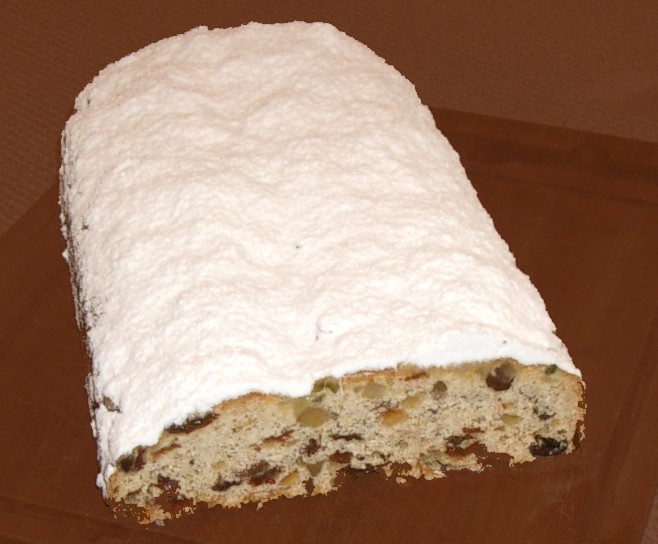
The German Christmas kitchen is famous the world over. Baking begins well before the season and fills the house with the smell of spice.
Stollen is the great Christmas loaf, a dense fruit bread dusted heavily with powdered sugar, often with a ribbon of marzipan inside. The protected Dresdner Christstollen is the most celebrated version, and Dresden holds an annual Stollenfest at which a giant stollen weighing several tons is paraded through the city. Lebkuchen, the soft spiced gingerbread linked above all to Nuremberg, is the other great German Christmas bake. Families also fill tins with Plätzchen, small cut out Christmas cookies, to share with every visitor through the holidays. For more festive bakes from across the globe, see our guide to Christmas foods around the world.
Then there are the Plätzchen, the small Christmas cookies baked by the tinful: buttery Vanillekipferl crescents, cinnamon star Zimtsterne, and spiced Spekulatius biscuits stamped with pictures. The northern city of Lübeck is famous across Europe for its fine marzipan, shaped into fruits and figures and given as gifts. Every household seems to guard its own treasured recipes, and the cookies are shared out among neighbors, teachers, and friends through December.
Crafts, Carols, and the Ore Mountains
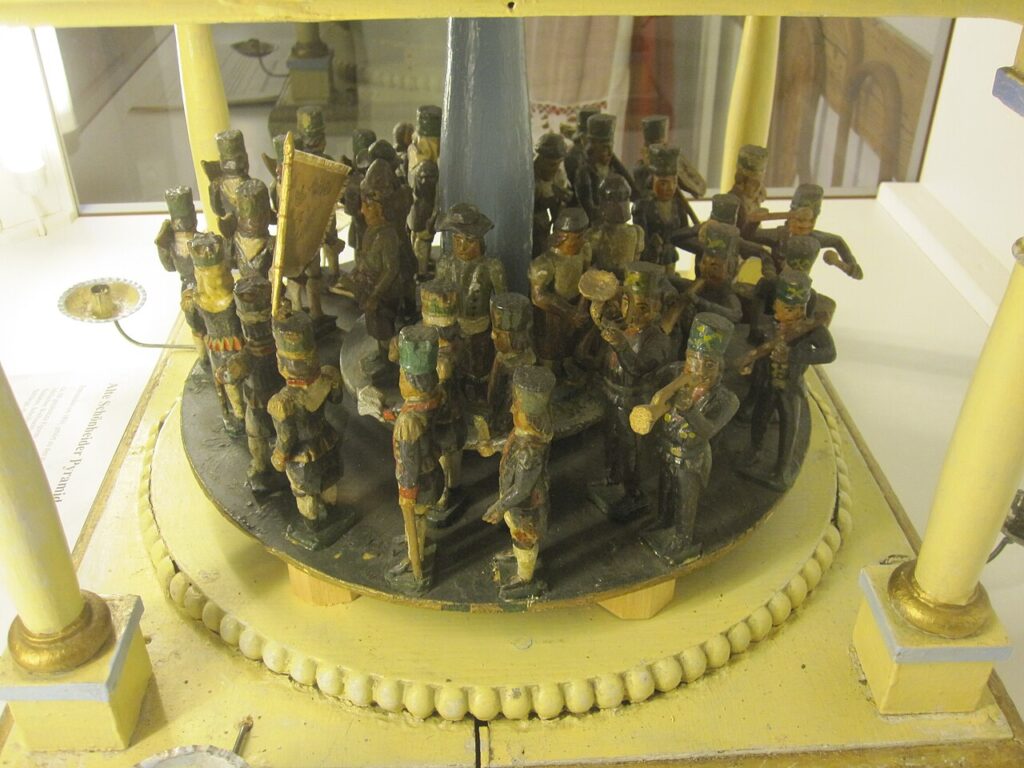
Much of the woodwork that decorates Christmas around the world comes from one German region, the Erzgebirge, or Ore Mountains, where carving was a winter living. From here come the painted nutcrackers, the Räuchermännchen incense smokers that puff fragrant cones, and the Christmas pyramid, a tiered wooden carousel turned by the rising heat of its candles. In some German homes the pyramid, not the tree, is the glowing centerpiece of the room.
Music runs through the whole season. “O Tannenbaum” and “Stille Nacht” are sung at markets, in churches, and around the tree, though Germans will tell you that “Silent Night” was actually first sung just over the border in Austria, in 1818. For the symbols behind all this woodwork and greenery, see our guide to Christmas symbols and decorations.
One Country, Many Christmases
Germany’s Christmas is not quite the same from one region to the next. In the Catholic south of Bavaria, the Christkind reigns and Alpine customs such as the Krampus run color the season. In the Rhineland around Cologne, the great markets and the cathedral set the tone. The eastern Erzgebirge fills its windows with carved wooden arches of lights and turning pyramids, while the northern ports look to Lübeck’s marzipan and a more restrained, Protestant celebration.
One shared thread runs from Christmas on into the new year: the Rauhnächte, the “rough nights” between Christmas and Epiphany, were long wrapped in folklore and superstition, a quiet and slightly mysterious close to the festive season. Across all these regional differences, the German Christmas keeps its unhurried, candlelit character.
The Source of So Much Christmas
To celebrate Christmas in Germany is to stand at the origin of the holiday so much of the world keeps. The tree, the wreath, the calendar, the markets, and the gingerbread all began in these towns and homes, and they are still kept here with a particular care. The season is unhurried, lit by candles, and built around the slow approach of one holy evening.
Whether you visit a market in Nuremberg, light a candle on an Advent wreath, or simply bake a stollen at home, you are taking part in traditions that Germany gave the world. To explore how other countries celebrate, return to our guide to Christmas around the world, or the main guide to Christmas.