Every December, homes fill with the same familiar objects: an evergreen tree, a ring of greenery on the door, red flowers on the windowsill, stockings by the fire, and lights everywhere. We hang them without thinking. But almost every Christmas decoration started as a symbol, and most carry a meaning far older than the tinsel and glass we know today.
This guide explains the symbols and decorations of Christmas, where each one came from and what it stands for. Some grew out of ancient winter customs. Some carry Christian meaning. A few are simply good stories that stuck, and one or two are clever marketing dressed up as old tradition. Along the way it sorts the real history from the charming legends.
For the wider story of the season, see our complete guide to Christmas, and for how the holiday developed, our history of Christmas.
The Christmas Tree
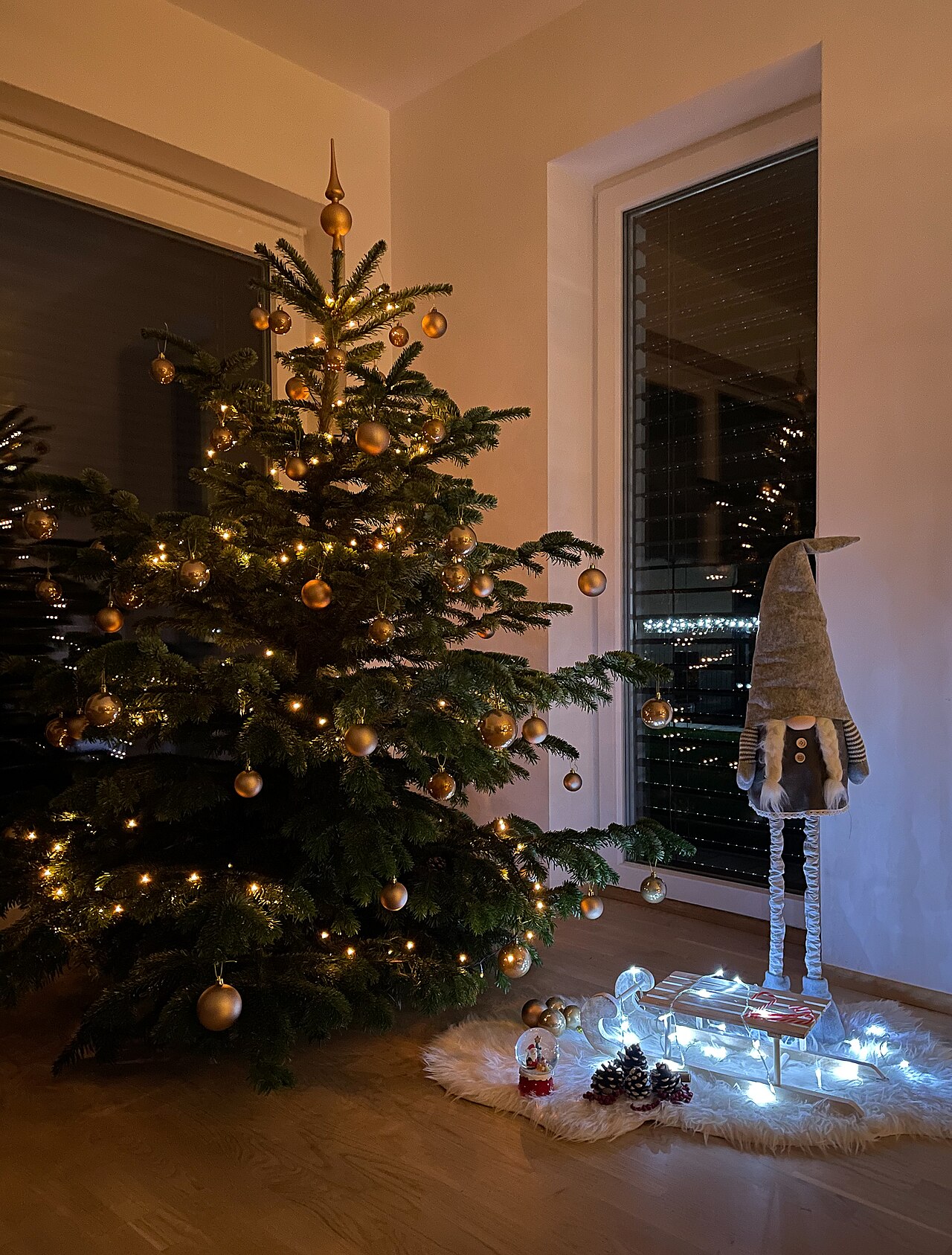
The decorated Christmas tree is the centerpiece of the modern holiday home, and it comes from Germany. By the 1500s, German families were bringing evergreen trees indoors at Christmas and hanging them with apples, nuts, and sweets. The choice of an evergreen was no accident. A tree that stays green through the dead of winter was a natural symbol of life that endures, and later of eternal life.
One ancestor of the tree was the medieval Paradise tree, a fir hung with apples that appeared in church plays about Adam and Eve on December 24. The round red apples on that tree are one reason we still hang round ornaments today.
A famous story credits Martin Luther with adding the first lights, said to have placed candles on a tree to recreate stars shining through the branches. It is a lovely image, but historians treat it as a legend rather than fact. What is better documented is how the tree spread to the English speaking world. Queen Victoria and Prince Albert, her German husband, were shown in an 1848 newspaper engraving gathered around a decorated tree, and the fashion swept Britain and America. The royal couple did not invent the British Christmas tree, an earlier queen had kept one, but they made it the must have decoration it remains.
The trees themselves are usually firs, spruces, or pines, each with its fans. The traditional Norway spruce smells wonderful but drops its needles quickly, while firs such as the Nordmann hold theirs much longer. Many households now use an artificial tree, a habit that goes back further than people think, to the feather trees of 19th century Germany and the shiny aluminum trees of the 1950s. Towns and cities, meanwhile, compete over giant public trees. The one in Rockefeller Center in New York has been a tradition since the 1930s, and the tree in London’s Trafalgar Square is sent every year by the city of Oslo as a thank you for British help in the Second World War.
Ornaments and Baubles
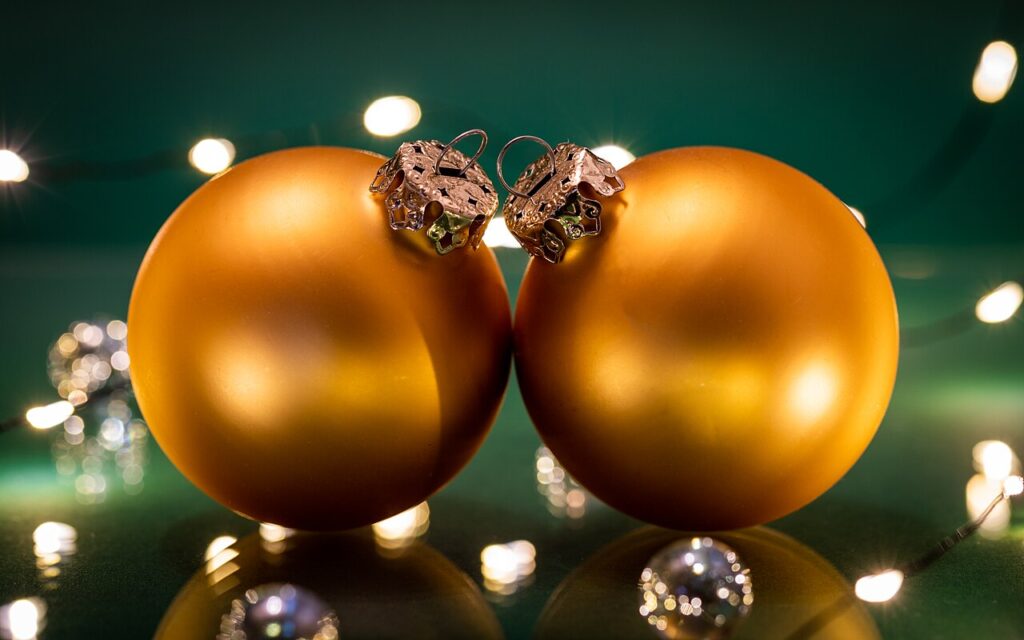
The shiny glass balls on the tree have a specific birthplace: the town of Lauscha in Germany, whose glassblowers began turning out delicate blown glass baubles in the 1800s that were soon exported around the world. Before glass, trees were trimmed with fruit, nuts, paper, and candy. The apple of the old Paradise tree slowly became the shiny red ball we hang now, and a craft that started in one small German town became a global industry.
The Christmas Pickle
Not every “old tradition” is what it claims to be. The Christmas pickle, a glass ornament shaped like a gherkin hidden in the branches for a child to find on Christmas morning, is widely sold as an ancient German custom. In truth, most Germans have never heard of it. The likeliest explanation is that American shops in the late 1800s, importing German glass ornaments, invented a charming back story to help sell the pickle shaped ones. It is a neat reminder that a tradition can be barely a century old and still feel timeless.
The Star or Angel on Top
The figure crowning the tree is rarely random. A star stands for the Star of Bethlehem, which the Gospel of Matthew says guided the Magi to the child. An angel recalls the angels who announced the birth to the shepherds. Either way, the topper points back to the Nativity story at the root of the holiday, turning the whole tree into a kind of pointing finger toward heaven.
Tinsel
Tinsel was once made of real silver, thin shimmering strands draped to catch candlelight. Because silver tarnished, it was later replaced by cheaper materials, but the glitter stayed. A folk legend from Eastern Europe explains tinsel as the work of a spider. As the story goes, spiders spun webs over a poor family’s tree overnight, and the strands turned to silver and gold in the morning light. You can read that tale in full in our guide to Christmas around the world.
Christmas Greenery
Long before Christmas, people across the northern world brought evergreen plants indoors in midwinter. Green branches in the cold, dark months were a sign that life went on. Christianity gave these old customs new meaning rather than sweeping them away.
The Wreath
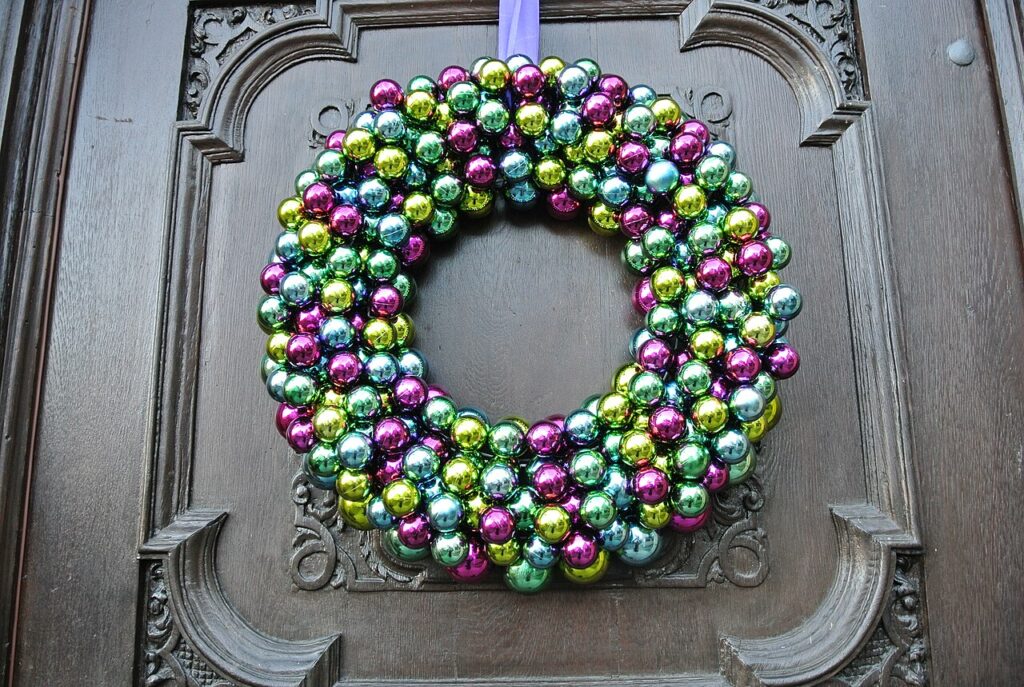
The Christmas wreath carries meaning in its very shape. A circle has no beginning and no end, so it stands for eternity, and the evergreen it is woven from stands for everlasting life. Hung on the front door, a wreath has also become a warm sign of welcome. Inside the home, the Advent wreath, with its four candles, marks the weeks of preparation before Christmas, a custom covered in our guide to the religious meaning of Christmas.
Holly and Ivy
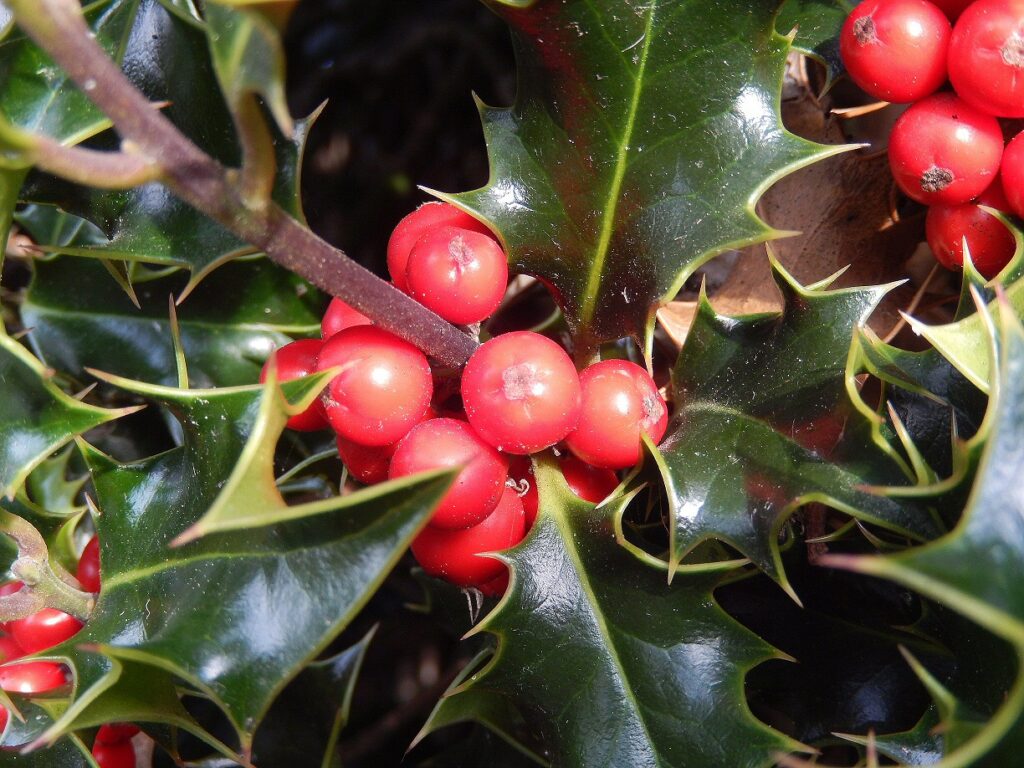
Holly was prized as winter greenery long before the Christian era, valued for staying green and bearing bright berries in the cold. Romans and Celts alike brought it indoors in winter. Christians later read their own meaning into it: the sharp, spiny leaves recalling the crown of thorns, and the red berries the drops of blood. The old carol “The Holly and the Ivy” pairs it with ivy, another evergreen, in a song full of this symbolism.
Mistletoe
Few plants carry as much old magic as mistletoe. It was sacred to the Druids, who cut it from oak trees with great ceremony, and it appears in Norse mythology in the story of the death of the god Baldr. Because it stays green and fruits in winter, it was linked with life and fertility. The custom of kissing under the mistletoe took hold in England, where tradition said a man could kiss a woman standing beneath it, and a single berry was plucked with each kiss until none were left.

The Poinsettia
The red poinsettia is native to Mexico, where it is known as the Flor de Nochebuena, the Christmas Eve flower. A Mexican legend tells of a poor child who had no gift for the church on Christmas Eve and gathered a handful of roadside weeds, which burst into brilliant red blooms at the altar. The plant takes its English name from Joel Roberts Poinsett, the first United States envoy to Mexico, who sent samples home in the 1820s. What look like red petals are really colored leaves, and their star shape helped make the plant a Christmas favorite across the world.

The Yule Log
Before the bûche de Noël became a cake, the Yule log was a real log. In parts of pre-Christian Europe, a great log was carried in and burned on the hearth over the days of the midwinter festival, its warmth and light pushing back the longest nights of the year. A piece was sometimes saved to light the next year’s log, a small chain of continuity from one winter to the next. The French later turned the memory of it into the rolled chocolate cake described in our guide to Christmas foods around the world.
Garlands and the Kissing Bough
Greenery did not stop at the door. Long ropes of evergreen, called garlands, are draped along mantels and stair rails to carry the look of the wreath right through the house. In England, before the German tree arrived, the main indoor decoration was the kissing bough, a ball or frame of evergreen hung from the ceiling and trimmed with apples, candles, and a sprig of mistletoe. People kissed beneath it just as they later would under a single bunch of mistletoe. When the decorated tree caught on in the 1800s, it slowly pushed the old kissing bough aside.
The Light of Christmas
Light is the oldest Christmas symbol of all. The festival sits at the darkest point of the northern year, and the lights of Christmas all speak of light overcoming darkness, a meaning both ancient and Christian.
Candles
Candles have glowed at midwinter for thousands of years. In the Christian home a candle placed in the window became a sign of welcome, said in some traditions to light the way for travelers, or for Mary and Joseph in search of shelter. For centuries, real candles were clipped to the branches of the Christmas tree, beautiful and rather dangerous, with a bucket of water often kept close by.
Christmas Lights
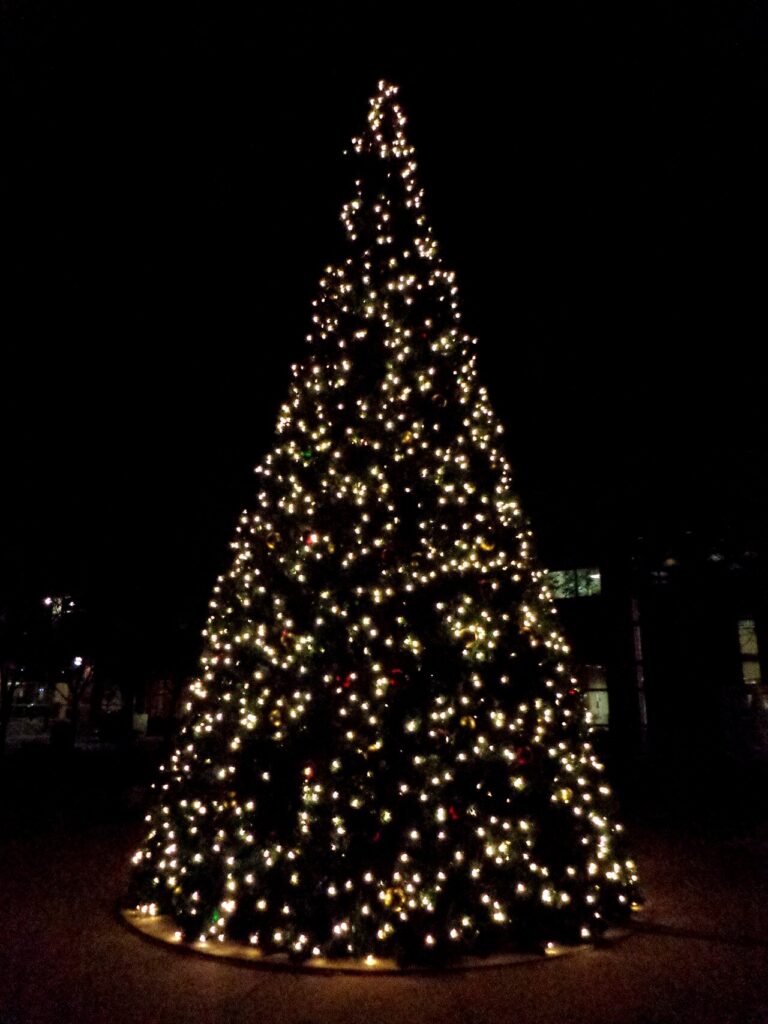
Electric lights changed everything. The first electrically lit Christmas tree was the work of Edward H. Johnson, a colleague of Thomas Edison, who strung hand wired bulbs on a tree in New York in 1882. Safer and brighter than candles, electric lights spread quickly. Today whole houses and city streets disappear under them each December, and some neighborhoods turn the friendly rivalry of who can light up the most into a yearly spectacle.
The Christingle
One of the most charming light customs is the Christingle, an object built entirely of symbols. An orange stands for the world, a red ribbon around it for the blood of Christ, four cocktail sticks of fruits and sweets for the four seasons and the gifts of creation, and a lit candle pushed into the top for Christ, the light of the world. It began in the Moravian Church in Germany in the 1700s and is now a favorite at children’s services, especially in Britain.
The Christmas Pyramid
In parts of Germany, the glowing centerpiece is not a tree but a Christmas pyramid, or Weihnachtspyramide. It is a wooden carousel of several tiers, often carved with nativity figures, topped by a propeller of blades. The heat of small candles set around it rises and turns the propeller, which slowly spins the figures below. In the mountain towns of the Erzgebirge, where it was made, the pyramid is older than the decorated tree, and giant market square versions still turn above German Christmas markets today.
By the Hearth and Around the Home
Christmas Stockings
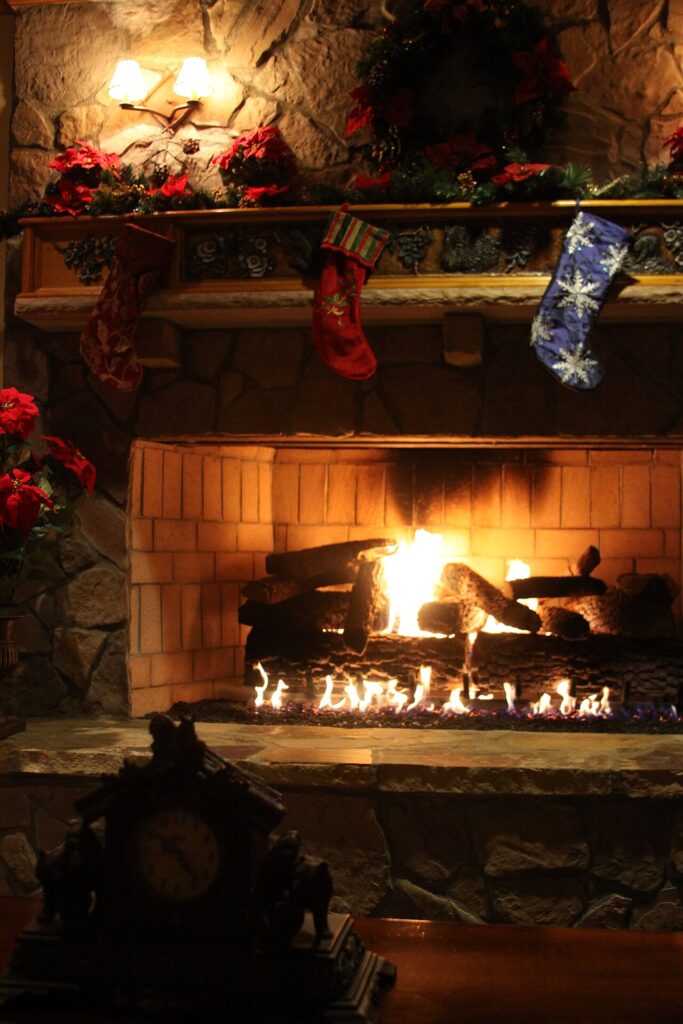
The Christmas stocking reaches back to the legend of Saint Nicholas. The story tells of the saint secretly tossing gold through a window to help a poor family, where it landed in stockings left to dry by the fire. Children have hung stockings by the hearth ever since, hoping to find them filled in the morning, traditionally with small gifts, nuts, and an orange in the toe. The figure of Saint Nicholas is also the ancestor of Santa Claus, a story told in our guide to Santa Claus and the world’s gift-bringers.
The Nativity Scene
The nativity scene, a model of the stable with the holy family, shepherds, and animals, is among the most meaningful Christmas decorations. It is traditionally credited to Saint Francis of Assisi, who set up a living manger scene in Italy in 1223 to help people picture the humble birth. From churches it moved into homes, where families set out the figures through Advent and place the Christ child in the manger on Christmas Eve. In Italy the craft of the presepe became an art form, and whole village scenes are built around the stable.
The Nutcracker
The painted wooden nutcracker, shaped like a soldier or a king with a lever jaw, comes from the Erzgebirge mountains of Germany, where woodcarving was a winter living. By tradition the fierce little figure was thought to guard the home and bring good luck. Tchaikovsky’s ballet The Nutcracker, first staged in 1892 and now performed every Christmas, turned the carving into a worldwide symbol of the season.
Christmas Cards
The Christmas card is younger than it looks. The first commercial card was commissioned in London in 1843 by Sir Henry Cole, who wanted a quick way to answer his many holiday letters, and was illustrated by John Callcott Horsley. The idea took off as printing grew cheaper and postage spread, and soon mantelpieces everywhere were lined with cards from friends and family. Displayed across the room, they became a decoration in their own right, a paper record of who had thought of you that year.
Robins, Snowmen, and Winter Friends
A few creatures became Christmas decorations almost by accident. The robin appears on countless British Christmas cards because Victorian postmen, who delivered those very cards, wore bright red coats and were nicknamed “robins.” The cheerful snowman stands for the simple fun of a white winter, and reindeer, with holly around their necks, recall Santa’s sleigh team. Lit ceramic Christmas villages bring a whole snowy town to the mantel. None of these carry deep ancient meaning, but they crowd the season’s cards, jumpers, and window displays. Christmas, it turns out, keeps gathering new symbols as it goes, and each generation adds a few of its own.
Christmas Bells
Bells ring through Christmas for a reason. Church bells once called worshippers to Christmas services, pealing out across towns and fields to announce the feast. In folklore, the ringing of bells also carried the warm idea of guiding the lost safely home, and bells remain a favorite shape for ornaments and wreaths.
Candy Canes and Gingerbread
Some sweets became symbols in their own right. The candy cane, a white stick with red stripes, is often said to be shaped like a shepherd’s crook or a letter J for Jesus, with the red standing for Christ’s blood. These are appealing stories, but they are later inventions rather than the documented origin of the candy. The gingerbread house, meanwhile, is a German tradition that grew popular alongside the Brothers Grimm fairy tale “Hansel and Gretel,” with its cottage made of bread and sweets. Decorating one has become a family event in itself.
The Colors of Christmas
Two colors say “Christmas” instantly: red and green. Both have deep roots in the greenery of the season. Green is the color of the evergreens, of holly, ivy, and the tree, standing for life that lasts through winter. Red is the color of the holly berry, and in Christian symbolism the color of sacrifice and the blood of Christ. Gold and white join them to suggest light, royalty, and purity, the gold of the Magi’s gift and the candlelight of the season.
The familiar red and green pairing is old, carried by the holly that has decorated winter halls for centuries. Modern advertising and the red suited Santa later cemented the combination in the public eye, but the colors were on the holly long before they were on any billboard. Other places lean on different shades, from the cool white and silver of a Scandinavian Christmas to the bright gold of a southern one.
When to Put Up and Take Down the Decorations
The decorations have their own calendar. Traditionally, many households waited until Advent or even Christmas Eve to put up the tree, rather than the day after Halloween. Taking them down has an even firmer rule in some countries. By old English custom, all Christmas greenery should be down by Twelfth Night, the evening that ends the twelve days of Christmas in early January. Folklore warned that leaving it up past then would bring bad luck for the year. Others keep their decorations until Candlemas in early February, stretching the season as long as they can.
Christmas Symbols at a Glance
| Symbol | Origin | What it means |
|---|---|---|
| Christmas tree | Germany, 1500s | Evergreen life through winter |
| Wreath | Ancient greenery custom | Eternity and welcome |
| Holly | Pre-Christian Europe | Crown of thorns, drops of blood |
| Mistletoe | Druid and Norse lore | Love and a kiss |
| Poinsettia | Mexico | The Christmas Eve flower |
| Yule log | Pre-Christian Europe | Light and warmth in deep winter |
| Stocking | Legend of Saint Nicholas | Gifts for good children |
| Candle and lights | Ancient midwinter | Light over darkness |
| Star or angel topper | The Nativity | The Star of Bethlehem, the angels |
| Nutcracker | Germany, Erzgebirge | A guardian and good luck |
| Bells | Church bells | Announcing and guiding home |
| Red and green | Holly and evergreens | Life and sacrifice |
Old Meanings, New Homes
Look closely at any Christmas room and it tells a layered story. The evergreen, the holly, and the Yule log come from ancient winter rites. The star, the stocking, and the nativity scene come from Christian faith. The glass bauble, the electric string of lights, and even the marketing born pickle come from the workshops and shops of the modern age. All of them now hang side by side, their old meanings half remembered but still glowing.
That is the quiet pleasure of knowing what the decorations mean. The next time you hang a wreath, top the tree with a star, or pause under the mistletoe, you are repeating a gesture that may be centuries old. To see how these symbols appear in celebrations across the globe, explore our guide to Christmas around the world, or return to the main Christmas guide.